
The Future of Gene Therapies and CDMOs with Philip Ramsey
December 2, 2025
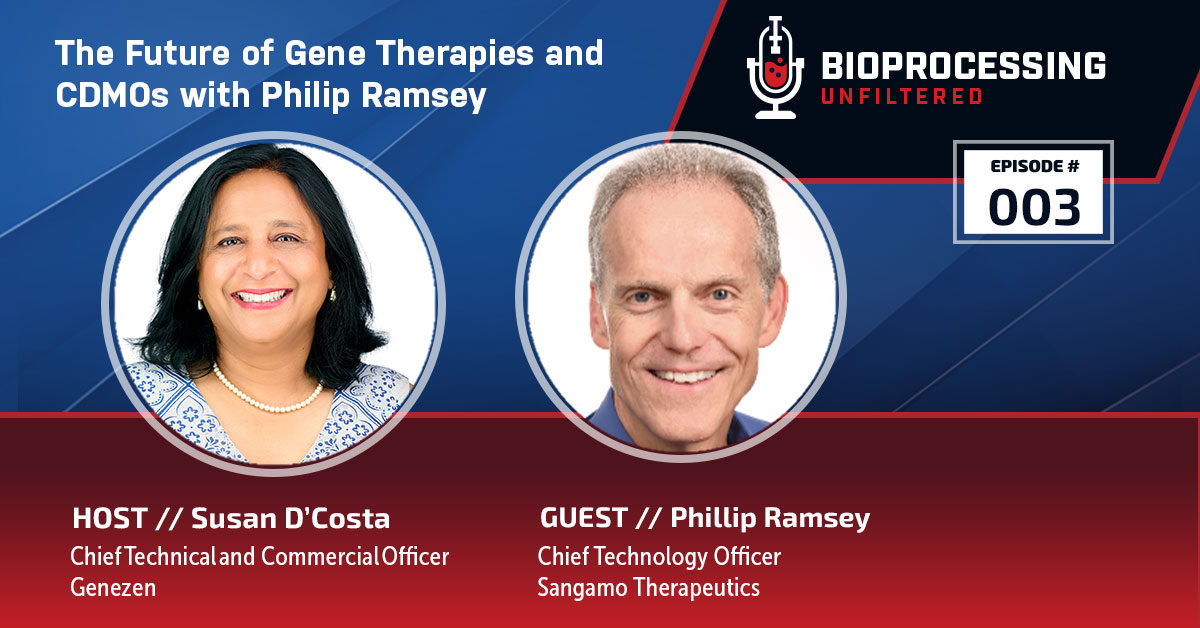
What is the future of gene therapies? In this episode of Bioprocessing Unfiltered, host Susan D’Costa, chief technical and commercial officer of Genezen, and Phillip Ramsey, CTO of Sangamo Therapeutics, discuss a variety of topics about gene therapies, including what will transform viral vector gene therapy, the evolving role of contract development and manufacturing organizations (CDMOs), and how gene editing in general fits into the broader gene therapy landscape. Plus, they cover the three key factors that are important in a relationship with a CDMO and the onslaught of different pressures that cell and gene therapies are currently under—and how to rekindle confidence in managing that pressure and tackling challenges.
GUEST BIO
Phillip Ramsey, CTO, Sangamo Therapeutics
Phillip Ramsey is the CTO at Sangamo Therapeutics where he oversees manufacturing, technical development, supply chain and quality. He has over 35 years of experience in biotech and pharmaceutical operations, development, and quality and has been active in multiple therapeutic areas including autoimmune, cardiovascular, central nervous system, emerging infectious diseases, oncology, rare genetic diseases, and vaccines. Prior to joining Sangamo, Phillip was Senior Director at Emergent BioSolutions where he played a key role in the design and construction of a 85,000 square foot award winning commercial facility, as well as Leidos where he was a part of the development of a 130,000 square foot vaccine pilot plant for the NIH. Additionally, Phillip has contributed to multiple regulatory submissions for product approval and more than 50 investigational new drug submissions. Phillip received his B.S. in Chemistry and Physics from the University of Nebraska, an MBA with a specialty in regulatory sciences from San Diego State University, and his M.S. in Biochemistry from John Hopkins University.
HOST BIO
Susan D’Costa, Chief Technical and Commercial Officer, Genezen
Susan D’Costa is a molecular virologist spanning 25 years of experience in virology. Over the past twelve years she has translated her expertise into viral vector gene therapieswhere she has been actively involved in viral vector analytics, process development, manufacturing, and building successful teams. She serves as a board member for Elly’s Team, a parent foundation focused on accelerating the translation of medical research into treatments. She also serves on the Scientific Advisory Board for Precision Biosciences, a clinical-stage biotechnology company focused on developing genome editing therapies using its proprietary ARCUS® platform. Prior to Genezen, Susan was CTO at Alcyone Therapeutics, a biotechnology company pioneering next-generation CNS precision gene-based therapeutics for complex neurological conditions. At Alcyone, she was responsible for viral vector CMC, device development operations and partnering on new technologies for both gene therapy and precision delivery. Dr. D’Costa has also held leadership roles of increasing responsibility at Thermo Fisher Scientific, Viral Vector Services and its predecessor companies – Brammer Bio and Florida Biologix, working with different viral vectors, liaising with diverse biotech clients and building teams with scientific and operational excellence. Susan holds a Ph.D. in biology, specializing in molecular virology, from Texas Tech University; an MS in biochemistry from Mumbai University (Grant Medical College) and a BS in microbiology/biochemistry also from Mumbai University (St. Xavier’s College).
TRANSCRIPT
Announcement:Welcome to the Bioprocessing Unfiltered podcast. Each month we host conversations with the researchers and leaders tackling and solving the day-to-day challenges of the bioprocessing industry.
Susan D'Costa:Hi, I'm Susan D'Costa. I'm the chief technical and chief commercial officer at Genezen. Genezen is a contract development manufacturing organization that works with viral vectors for cell and gene therapies. And today I'm talking with Phillip Ramsey, who's the chief technical officer at Sangamo Therapeutics. Welcome, Phillip.
Phillip Ramsey:Thank you, Susan. Good to be with you.
Susan D'Costa:Good to be with you as well. I just wanted to take uh a moment to have you introduce uh yourself, tell us a little bit about your background and what drew you to gene therapies. And as you're answering that question, can you also give us a little bit more on your background for the uh different modalities that you walked in for advanced therapies? And how would you then say the CMC aspects of gene therapies are as compared to those? Like how are they more complex, if you can sure maybe answer that?
Phillip Ramsey:Yeah, yeah. Um, yeah, well, I think like a lot of people, my background uh and story kind of nicks in a weird way. So my background is as a biochemist. Um, and also uh I went back and got a business degree too to kind of help help me out from a management perspective. Um I was rooking the CRO world when I first got out of school. And then I moved to San Diego to go back to graduate school, and I got hooked into this little company called Vikel. And there we were working on some pro drugs, which was not super exciting. But then as a skunk project, we had, we were working on uh the delivery of RNA and plasma DNA using liposomes. And my manager at that time had a background who developed the first cadiac lipids. So our lab was really uh focused on um generating new canonic lipids, figuring out if we could make artificial liposomes and viral particles. And we ended up making some of the first LNPs to deliver RNA. And it was just kind of an exciting everyday, you know, like what kooky idea does do we have next, you know? And oh, can we work on that kooky idea? Sure, you know. So uh that's really hooked me into kind of biotech. And I just couldn't pull back after that. I I knew that's where I wanted to be. Um, after that, you know, of course, I worked on a lot of different modalities. So you said um different biologics, proteins, uh, really got heavily into vaccines, um, using multiple modalities, even within that. So there I'd worked on uh a denovirus, uh MDA modified vaccinia, uh, anchor virus, uh, to deliver a variety of different viral uh vaccine targets and emerging infectious disease targets. So um just one of those things I think a lot of people will find in their careers, you kind of serendipity, you end up somewhere and you go, this is the right spot, and you don't leave it. Right. So uh and then from the complexity standpoint, I think like a lot of people present in a lot of meetings that we see, um, I kind of equate the small molecule to biologic to uh gene therapy from the bicycle to the car to the jumbojet scenario to help most people kind of go, well, how complicated is this? And it gives them a relative point. I think that's uh easier to understand.
Susan D'Costa:Well, that's great. As as you were talking, I was thinking you made mention of viruses. And my entire career has been being a molecular virologist. And you talked about uh MVA, modified vaccinia an kara. That was my postdoc. I spent about four years working with vaccinia. So brought back some really good memories for me on all the various ways, you know, and like you said, once you get passionate about something, you're hooked and you can't go away from it. And that was viruses for me. So I was lucky to be part of the viral vector gene therapy landscape here. Yeah, yeah. Let's talk a little bit about innovation and future directions. Um, as you know, gene therapy is in innovating, evolving quickly. Whether we're talking about new capsids, we're talking about new ways to deliver, these are always happening like constantly, maybe in equilibrium with what was currently happening. But considering what is happening right now, maybe things in viral vectors in general, what do you anticipate the next two to five years would look like? Um, and what do you think will transform viral vector gene therapies in general?
Phillip Ramsey:Yeah. I yeah, it's a great question. I think that we all wrestle with this. And I think one thing that people forget, they get so enamored with their own technology. Every kind of, and you see this a lot, I think. Every little biotech is so enamored with their own technology that that's the way everything has to be. And I think we need to back up and really think about that and say, hey, wait a minute, is this the right tool? Right. Uh as you know really well, there's so many things in the toolbox. Uh, gene therapy may or may not always be the right uh tool. You know, lentivirus was not the right tool for everything, but it's the right tool for some things. I think now we're seeing the popularity of AEV uh as a viral vector system as probably very good in a few areas, but not in every area. And I think that's the first thing I would recommend is people stop, uh step back and think about that. I think as uh well, I'll take the second piece first. I think AEV specifically um has a couple of modalities or a couple uh delivery routes that are really well suited for AAV. And one is obviously ocular, and the other I think is CNS, although the large barrier has been delivery. So, but I think both of those uh can really take advantage of AEV in a way that liver delivery has not been able to. Because you have hepaticide turnover with neuronal cells and then in the vitreous tissue and the eye, you don't have that.
Phillip Ramsey:So I think a lot of companies are showing really good results for ocular opportunities like Wixterna. And I think also once the blood-brain barrier uh is solved, then CNS that opens up CNS. Uh so then going back to the first part, I think that those two pieces uh are really uh uh huge innovators, I think, in the field. And one is the delivery um with these novel capsids that are being invented every day. And you know, a company has another one. And then the other thing I think that's really important, especially for AV, but probably uh to some extent a lot of genetic vectors, but I think AV especially, because it's so promiscuous and how it replicates, is uh AI-driven improvements to the genetic material that's being used. Um, that a lot of companies now uh are kind of in that space trying to look at truncations and other issues with the sequencing uh of your of your genomic product that's in that virus. And if you can make improvements to that, you may be able to do a better job at encapsulation so you don't have MP capsids as a safety issue. Uh, but probably more importantly, it'll make the whole delivery more efficient and high, you know, possibly improve potency and certainly a much better safety profile from truncations, deletions, et cetera.
Susan D'Costa:Right. So it kind of brings me to the question as well on redosing, right? We've been talking about these viral vectors, but one of the biggest concerns here is it's a one and done kind of conversation. They don't know how robust they are. What do you think innovation is going to look like in terms of being able to bring some level of redosing? So even if you take hemophilia, for example, we don't know how long or how durable the phagocyte will be in being able to maintain yet. And if these are young kids, then at what age will that change? Uh and then if you're going into the CNS space, is that something that will continue to stay robust as well?
Phillip Ramsey:Yeah. Yeah, I think uh certainly when the first few applications go in in CNS, we'll see. Maybe you're right, there's no clinical data to support that yet. Um, I think um for the hepatocyte turnover and redosing, I think there are a lot of groups working on redosing strategies, but uh, and you may know better than I, but I haven't seen anything that I go, wow, that's gonna do it, right? I see some incremental movement there, but I don't see anything uh that I I think is substantial at this point. Um what I do tell a lot of folks though is I I do see people getting into applications where the next thing they do after they get product approval is they should start working on how to redose. So not what everybody wants to hear. But I think there that's that's a reality. I think the other piece that people may forget about is, and I saw this a lot in large HIV trials with adenovirus, is that zero, uh zero conversion can happen, but also there's a lot of uh pre-existing immunity in different areas. So in some indications, that could be, you know, more than 50%. So I I think that's something, you know, again, some small companies getting into new indications kind of jump into it and like, oh, we're really excited about this. But then they look and they go, Well, you know, there's a 60%.
Susan D'Costa:I mean even with the novel capsids.
Phillip Ramsey:Well, I think with novel capsids that you're you're getting over that. That's true. Yeah, maybe maybe we we don't understand that enough, right? So when people are uh fiddling with a viral protein three and they're manipulating the variable loops, we're not really sure what the binding site is that uh we're gonna see with our adapted immune system. So um that to be determined. Yeah.
Susan D'Costa:I I think I saw something about um IgG antibodies to maybe specifically to the RH 74 serotype uh with HANSA, I think it was HANSA Biopharma, where they can actually um kind of get rid of the IgG antibodies. So maybe make that more medible uh to redose or to be able to improve or decrease the exclusivity or in increase the inclusivity of the patients that can then get dosed with the Sarepta semicodein DND uh uh vector. But that's that's a way to think about that one as well, I guess.
Phillip Ramsey:And I think to your point, it it could be a combination too, where you do some kind of immunomipulation along with the novel capsid. And maybe as people are reiterating new and new cap new and uh more innovative capsids, that has to be one of the things that goes back into the design. Correct. Right.
Susan D'Costa:That makes sense. Yeah. Yeah. So I think talking about dosing and redosing, we get straight into how do we make those doses. CMC is a big conversation always. Manufacturing costs come up very often and kind of understanding the cost of goods. And unfortunately for what we do, you know, because I think we don't have enough time between discovery to actual commercialization, um, we kind of get more hobbled processes ready for prime time. I think uh Luxterna was made in roller bottles, um, heme genics is made in in-wave reactors. Um even uh Bekes was made in roller bottles, if I'm uh remembering correctly. So when you think about the more archaic ways of doing uh cell culture and try to get to that process, I think that's added on to the conversation on being really difficult in terms of manufacturing. So I would love to see what you think are the main cost drivers today, especially for you know Sangamo products, because you're working more with the state-of-the-art technologies and kind of drive that, whether that's raw materials, whether that's maybe a process efficiency, scalability. And what do you think would be the platform approaches in this context? And how does FDA or any other regulatory agency play a role here to be able to drive that platform ability in this context?
Phillip Ramsey:Sure. Yeah, that's uh uh one of the big questions for all of us. I think um I do think there's a lot uh I'll get into that in a minute, but I do want to stop and kind of remind people, I think what's really important is to understand design, right? Um, I'm sure you have a lot of clients that come to you or are like, oh, I have to do this and it has to be this way. And, you know, but I want it cheaper, right? And you're like, well, no, you've you've set it up in a way that's gonna be pretty costly. And whether that's improved, um, you know, again, like AI-driven uh contents going in with the gene of interest, whether that be new and novel capsids, there's gotta be some better design to drive down to drive up potency, which will then drive costs down. So I would just put that out there as kind of the first big one. Um, I think in general, you know, we're still pretty specialized, even though we've been at this for a long time. And I like to say, uh, especially in the AV field, we we always want to do everything for the first time. And it's you, people have been iterating different pieces for since a 25 years, you know, but we're still having some of the same conversations of like, well, I just started with this new uh capsid, so now I have to modify my process.
Phillip Ramsey:So it's not everything, but some of those raw materials are going to be different. And some of the raw materials are are really not industrialized yet. So their cost is still fairly high. And there hasn't been enough competition in that space, and probably innovation from suppliers too, I think. Um certainly processes are not as efficient as what you see, say, with monoclonals, uh, where they've driven down costs tremendously and driven uh productivity up. Um and I think scalability in some of the examples you mentioned are, you know, it's insane. I mean, we were very excited when we saw Avigine's robot with all the roller bottles, moving the roller bottles around. It was like, oh, that's that's really cool. And then you and now I look back, I'm like, what insanity is that? You know, exactly. But they were trying to get medicines to patients. So you do it however you can. Um, I I I do think though uh these iterations have really curtailed us from uh being able to scale. So obviously, HEK293 production of AVE is a good example of where, you know, can anybody break the 500-liter barrier? You know, not sure.
Susan D'Costa:Even the question, right? I feel like there's only one cell line, HEK293. Well, Cher cell lines were the are the only ones that we use for monoclonal antibodies. But have we actually taken that step to say, is that the best cell line that we can leverage for making AAV vector? I don't know that we are plasma DNA, same question. Understanding plasma DNA, why are we using a process that's that's so difficult and such high cost and stopping materials? Yeah. Uh things like that, I continue as a CDMO is very it's much more frustrating for us because if you have to be custom and bespoke for every client coming in, then the chances that you're going to help a customer to get quick to clinic when you're talking about rare and ultra-rare are low. So I call these the you get what you get and you don't draw a fit kind of processes, which really are not very viable. They get you to first in human and then we'll start to reinvent the wheel when you're talking about late stage. But by that time, the investment becomes higher, the cost of goods becomes even more higher and untenable in some ways, right?
Phillip Ramsey:So yeah, yeah, yeah, totally agree. You you bring up great points there. I think you to your uh question about platforms, I think that's really a place where we can kind of turn the crank similar to monoclonals, right, and other proteins. Uh that's gonna take a while, and we're gonna have to repeat the same thing, like I said, twice or three times. Um and uh I think with the FDA's platform designation, or at least the the the offer, at least one was designated, uh, was Rupta. I think there's an opportunity there too to get the right data of the agency so that future programs can go faster to your point and leverage some of the prior knowledge. Um, but it's there's just a lot of work that has to be done. And I do think that uh the other piece I would add is cell line development is critical to all of this. I think the idea of, you know, we would we would look at it and say, well, we've done monoclonals with transient transfection to get quickly to the clinic. And then of course we went into a transformed cell line to give us more time and uh to get the cell line ready, but to compress the timeline. With AV, a lot of people are thinking, well, I'm gonna do this transient transfection all the way through. And that's, you know, should the there's two platforms you can look at where uh you could never do that and be competitive with a monoclonal. And I think the reality is when we look at uh cost of goods to your question, that's another piece. We have to say long term, we don't really have uh cost of goods solved. What we've done is we've used a new modality to treat a completely, many times an unmet medical need that gets support that just jams through to your porn.
Announcement:So are you enjoying the conversation? We'd love to hear from you. Please subscribe to the podcast and give us a rating. It helps other people find and join the conversation. If you've got speaker or topic ideas, we'd love to hear those too. You can send them in a podcast review.
Susan D'Costa:Sangamo's done a great job with platform ability, right? When you think about your SF9 backyard process, yeah, that you've been able to leverage at least the helpers for multiple different uh assets and constructs and then be able to work your way. But there has been definitely some investment up front to be able to make that happen. And knowing what you know today, do you still think that would that's the best path that's on the took forward?
Phillip Ramsey:Yeah, I think I think early on, um looking backwards, I think it was because I think the insect cell line system is just so much more efficient than anything, any mammalian system. So I do think that's been the case now for a while. Uh going forward, I'm not so sure. I do think a lot of effort needs to be made on cell line uh and everyone's playing with different cell lines. Do I do I use a cell line where, you know, we've heard some talks here at the at the meeting of do I infect it with ad helper and that's what initiates it? Uh do I try to do some kind of induction uh and make a completely transformed cell line? Do I go to back to a model more like with MBA or Adenovirus where I try to use a packaging system that could be more platformable for multiple products? Um I I don't I don't know the answer, but I think those are the questions people need to be asking when they're getting into this field and trying to determine how do I take these products to the patient? That's true.
Susan D'Costa:Yeah. So I guess the next uh topic that I want to talk about is the evolving role of CDMOs. And that it's definitely a topic nearer to my paycheck, for so to speak, right? Um, and as the field grows, um, sponsors continue to rely heavily on CDMOs, especially when there are conversations where your internal infrastructure takes a beating with reduction in force or some other ways that you know you're probably spending um your operational costs better by using external partners rather than doing all of it internally. Um so I was just curious, you do you think the current CDMOs are sufficient to meet the needs of this complex uh gene therapy market? Because uh with more innovative companies and especially large farmer coming in, better innovation can happen in-house rather than at the C DMO level. So how do we kind of navigate that conversation and partner?
Phillip Ramsey:Yeah, yeah. I think it's uh well, I think first of all, CDMOs are under incredible pressure. And I think when uh sponsors are trying to work and partner with them, they need to keep that in mind, that they have a bottom line, as you as you know very well. Um in my background, I give it every day. Yeah, yeah. And and I spend a lot of time in the CDMO world. So I I get it. I understand having PL responsibility and what that what that means. Um so uh in the other thing you you you said was partnering. I think sponsors, when they go in and work with the CDMO, I think they really need to understand that it has to be a partnership, which means you're giving a lot of information, uh, you're trying to give a lot of support. You know, uh sometimes I see people go, well, that didn't work. Well, okay. You're still responsible, you're the sponsor, right? So I think there has to be a link uh where both um both parties can be really successful. And, you know, there's some generalizations. I think they're good partnering, information sharing, uh, trying to act in each other's interest as best you can. Um, those are some generalities, but I think it's a relationship that has to develop where teams work together and get really good and support each other uh with a very clear goal in mind. I think a lot of times people will go in trying to get to the clinic, like you say, just bracing. But at some level, the goal has to be the sponsor in the C DMO eventually getting to a point where they're making a commercial product providing to patients. Then a lot of the issues that come up kind of go away because everybody's making enough money. They don't those it just kind of melts away and everybody's successful. Um, and that that's hard to get there. And it's hard to communicate, I think, to a lot of the staff, both in the sponsor and the CMO, that that's the end goal. That's what we're here to do. And everybody's hit with, as you know, you know, quarterly earnings. What do I say? You know, so sometimes it may be even having the frank conversations of where um, you know, we're we're looking for this long-term gain, and I know you'll be under pressure because of that. So how can I support that? Go ahead.
Susan D'Costa:Now, I just had a client very recently, a couple of days ago at the JSC, say to us there are three things that are important to him in the relationship with the CDMO. The first one, of course, was understanding the motivations on both sides. Like, what is your timelines? How are you trying to navigate it? And two was acting with urgency for those timelines and for the patients we're serving.
Phillip Ramsey:Yeah.
Susan D'Costa:And uh in in line with the motivations is like clean communication, really kind of putting those conversations and in the foreground to make it happen. Well, then it all ties together with transparency, like, you know, if things go wrong and they will go wrong, these are complex processes. But having those open conversations, having them transparently and as honestly as we can, because it's not a transaction or conversation, it's more of thinking about the higher level. Yeah. And that's something that, you know, has been driven into me, at least over the years that I've worked with C DMOs, um, as a CDMO with a CDMO, um, that it is important to have those conversations because it does take that brainstorming. It does take thinking outside the box. Because if you leave quality to do what quality does best, they're going to get super conservative and nothing's going to move. If you leave operations to do what they would want best, everything will slow down and tech transfer will take forever because they want it to be perfect. But that's when, you know, the business decisions have to be made. The teams need to come together and say, where are the risks? What are the risk mitigation strategies we can apply together so that you know we can understand that there will be risks. There's never going to be a zero-risk conversation. How can we mitigate those risks? As we're thinking becomes all the more important today when, you know, uh capital is lower and trying to make your dollars stretch as far as possible to make this work is even more important while still looking at very advanced therapies that are rare, ultra-rare. And the need to go to the market as fast as possible is still there, right?
Phillip Ramsey:So those are fantastic points. Yeah. Yeah. I I think um one thing that uh I've seen with a lot of the major CDMOs, and yeah, yeah, I'm sure you you're following this constantly, but just I think there's always a question of was capacity overbuilt? Was it underbuilt? Um, how do you utilize it? And I think on the sponsor side, everyone's playing the game of do I do I get help in the beginning so I don't have to make any commitment and then maybe I make a buy versus build later decision? Or it could be up front, I want to get quick to the clinic internally, and then I don't want to go to the very large expense of a commercial facility and then I go on. I think those are the questions that sponsors need to be asking themselves and having candid conversations with CDMOs.
Susan D'Costa:It's a good point to make. 2018, 2019, it was Builderville Khan. And so all of the large uh CDMOs went out and built huge amounts of facility space for so for some really good ideas in in in the mindset that they were thinking about. But so did Biopharma. Biopharma went Shen and built the same thing. And we saw like 22, 23, and even 24, that a lot of these facilities were just shut down, just shuttered, so many people out of jobs. These are highly skilled people that have excellent skill sets that they can bring to the table. And now they're looking at different aspects of kind of rebuilding what they started with, which is really sad to see how that conversation changed. So many of our colleagues are out there kind of trying to figure this out. So it's it's hard.
Phillip Ramsey:I I think there is some kind of balance where we're gonna have commercial success um and building capacity, right? We're just that balance isn't there yet. And I'm I'm sure many of the C DMOs are just kind of biting their teeth trying to decide how what what do we do. Uh and it's challenging. I think it's a challenging environment right now in biotech, I think, compared to any time I've been around for quite a while. I think this may be one of the most challenging times from capital availability um and all the stresses that are on the on the field.
Susan D'Costa:I think it all fits in with the idea because with biologics, you have these processes where you can continue to harvest for 99 days and you need the product again. The V-dosing is critical. Whereas if you're doing one and done, then you know, once the incident population is down, then what's left to kind of go after? And is that still a viable, a profitable business? Because at the end of the day, it has to be profitable for everybody that's in it to actually make it work. So yeah, no, I get it. It's so it's a complex conversation to have on both sides of the conversation. Yeah, no doubt. Yeah. It's kind of bringing this back a little bit more on the scientific aspect and thinking through gene editing, which as we both know Sangamo's really good at with yours like figure new placed technology. Um, how do you think gene editing in general fits into the broader gene therapy landscape? Um and how do you think it complements or maybe even diverges from tradition traditional AAB-based therapies?
Phillip Ramsey:Yeah. I think of uh gene gene editing, genomic medicines being uh, you know, if you can give those ex vivo or in vivo. Obviously, there are a lot of cell therapies out there. Uh, we've had several products. And I think that's a viable option, although you see the field mostly looking at how can they convert that to in vitro. Uh and then on the in vitro side, I I really see you know AV as being one of the most prevalent uh models going forward using that uh for delivery. But there are other mechanisms where people are using um uh LNPs and looking at a variety of systems to try to get those in there, uh into the into the body. Uh I think uh I think it will kind of add a little more uh a little more capacity or a little more oomph to gene therapy in general. It's kind of an I I guess I should say it's an extension. But it's still, again, it's a tool that can be delivered in a variety of ways. But I think those in gene therapy, if they're if they're smart and they think about it, if there's an opportunity that they can maybe do a traditional C DNA delivery, but also look at uh at any platform that they may have access to, you know, there's two ways to solve the uh pathology of a particular indication.
Phillip Ramsey:You you should definitely take that. I think for us, the the big piece has been delivery since we've targeted uh CNS. And our novel capsid system called SIFTR has really been kind of our mechanism to get there to generate capsids that can cross the blood-brain barrier. And obviously, there's a few companies that have been doing that with uh antibodies, finding the right ligand to be able to cross the blood brain barrier. But we we feel that getting um epigenetic editing uh into the brain is a could be a huge win for CNS. And we've done that uh currently working on our uh two programs, one for pain, uh leveraging the NAV 1.7 ion channel, and then also uh preon, where uh we feel is um a highly, highly unmet medical need and is a very small niche product that maybe a small company could take advantage of. Um and uh then um we also uh are looking at a variety of indications that we partnered. So we have partnered uh an anti-Tau for Alzheimer's with uh Genentech, and we also have programs with the Stellus and Lily. So I think there's a lot of interest there. And we have to prove it with human data, but uh I think that's really exciting for the gene editing.
Susan D'Costa:Are all of Sangamo's gene editing uh programs in AAB, or do you have some nonviral as well?
Phillip Ramsey:We uh have shut down most of the non viral ones that we were working on uh in the cell therapy space, I should say. Um yeah, but no, on the in vitro side, we use AAV. AAV as well, yeah. Yeah. I think it's important though that folks who are develop Developing new receptors and understanding this biology, try to leverage across, again, across different modalities, right? We don't want to get stuck on one tool just because we love it. Yeah. I agree. So uh but our our platform right now with those two pieces, the epigenetic regulation and the uh novel capsid is just a really good fit for these indications.
Susan D'Costa:And for your current uh Fabre uh program that's late stage, are you also using your gene editing technology or is that just that's a traditional c DNA delivery, the same as our HEMA program.
Phillip Ramsey:So yeah.
Susan D'Costa:Well, that almost brings us to the end of our conversation. But before we go, I want to kind of do what I said at the panel earlier this week, and that's call to action, right? I feel like cell and gene therapies in general are under an onslaught of of different pressures. Uh the market pressures, investment pressures, safety considerations. I feel like all of us in uh borovector gene therapies really need to kind of go out there and really understand where we can champion these conversations and where we think going down this path may not be where it needs to go. So, what are your thoughts on like rekindling that confidence in cell engine gene therapies?
Phillip Ramsey:Yeah, I think uh eventually, you know, human data is going to speak for itself. Uh so I think trying more new innovative technologies, getting those into patients, seeing if they work, and then leveraging those, uh, as I like to say, it's like it would be wonderful if we can get to something that we can just turn the crank and keep using it, right? Uh so I do think that we need to pay attention to safety. So I would think any sponsor who needs to think in terms of what else I can do to increase the safety profile of my product and uh kind of redig in on that because I think that's where there's going to be some erosion and confidence, especially around investors, if they see, you know, some of the therapies maybe having a little stumble here or there uh with a particular safety concern. So I, you know, I don't have the perfect answer, but I think the sponsors really need to think in those terms of how can I make sure that my stakeholders understand that, my patients understand that, regulators understand that, uh, or that I clearly understand the risk and I can communicate that to the regulators.
Susan D'Costa:Have you heard this old tale about the six wise men of Indostan? Um, they're trying to, they're all blind, the six blind men of Indostan, they're all blind and they're trying to figure out what an elephant is, like truly define the elephant, right? The man who's um standing by the trunk is feeling the trunk and saying the elephant is a very thick road. Um and uh the man who is standing by the ear is feeling the ear and saying the elephant is a big fan. And the man who's standing by the tail is feeling the tail and saying the elephant is a big snake. And then, you know, the foot and the leg. And you know, I feel like AAV and just Warwell back the gene therapies are like that. And if we don't bring all of the stakeholders, we should to the table, like Rachel was saying, I think we did ourselves a disservice when you first started with Warwell vectors, not to bring immunologists to the table, to ask the questions we don't know. And to kind of close this out, I feel like this is something we need to do as part of the call to action. You need to bring in and brainstorm from every aspect of the conversation, not just from a process engineering conversation or a clinical conversation or a tropism conversation. We need to bring in an understanding of the safety and what how the human body will respond to the therapeutic that we put in, as well as other considerations, um, you know, and bring all these stakeholders to the devo and be able to have more of a viable conversation in that week.
Phillip Ramsey:Yeah, I totally agree. I think that really flows into when you look back at monoclonals and where they were at 30 years ago, and it really wasn't even one large pharma that was able to solve it. It was a large group of companies and and scientists. So I think you're absolutely spot on there.
Susan D'Costa:Philip, it was a great uh pleasure to sit down here and talk with you. Thank you very much for joining us, and thank you, Dan, for a wonderful opportunity.
Phillip Ramsey:Great. Thank you. Always good to talk with you, Susan. Thank you.
Stay Connected