

Fireside Chat: Innovation and Investment in Biomanufacturing of Future Medicine
March 10, 2026
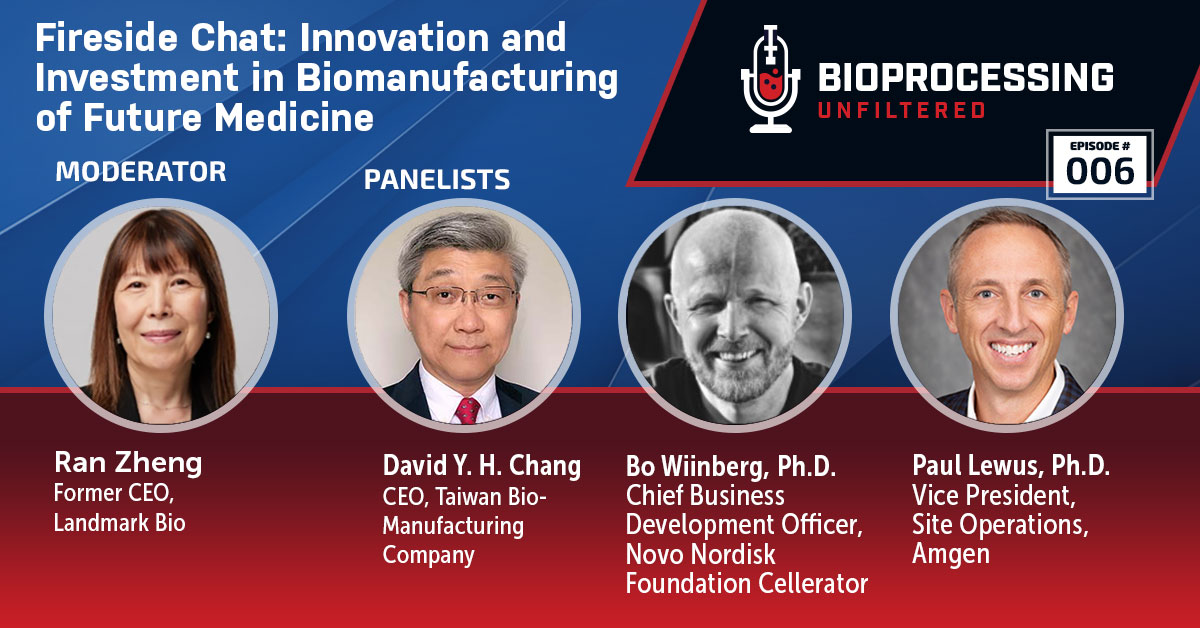
At the most recent Bioprocessing Summit, David Y. H. Chang, CEO of Taiwan Bio-Manufacturing Company; Bo Wiinberg, Chief Business Development Officer of Novo Nordisk Foundation Cellerator; and Paul Lewus, Vice President of Site Operations at Amgen gathered for a fireside chat moderated by Ran Zheng, former CEO of Landmark Bio, to discuss the technologies and innovations shaping the future of biomanufacturing. The conversation explored upcoming trends, investment opportunities, and modalities into the next decade, as well as the question: how should the industry best prepare for all of it?
PANELIST BIOs
David Y. H. Chang, CEO, Taiwan Bio-Manufacturing Company
Dr. David Chang has 30 years of industrial experience and is currently the CEO of Taiwan Bio-Manufacturing Company (TBMC) in Taiwan. Prior to his current role, he was CEO of Wuxi AppTec Advanced Therapies Business Unit located in Philadelphia, PA.; corporate VP and head of cell therapy global manufacturing of Celgene Corporation; the global head of engineering and strategy at Roche based in Basel, Switzerland; and the VP/site head of Roche Shanghai Technical Operations in China. Earlier in his career, Dr. Chang worked at Genentech as the senior director of global manufacturing science and technology, and as the director of process development at its Oceanside, California site. He was also formerly at Biogen Idec as director of cell culture R&D, at BASF Bioresearch as a cell culture group leader, and at Schering-Plough Research Institute as a process development engineer. Dr. Chang obtained his bachelor’s degree in chemical engineering from National Taiwan University in Taiwan, and his master’s and doctorate degrees in biochemical engineering from MIT in Massachusetts.
Bo Wiinberg, Ph.D., Chief Business Development Officer, Novo Nordisk Foundation Cellerator
Bo is a seasoned leader with extensive experience from both academia, the pharmaceutical and biotech sectors, focusing on strategic and operational leadership throughout the drug development value chain. Bo was previously an entrepreneur in residence at the BioInnovation Institute and at Novo Nordisk A/S, Bo held several leadership positions over the years, including head of strategy & operations for the Stem Cell unit. Bo is a doctor of veterinary medicine, earned a doctorate degree from the University of Copenhagen, and has numerous publications in peer-reviewed journals.
Paul Lewus, Ph.D., Vice President, Site Operations, Amgen
Paul Lewus is the head of site operations for Amgen’s new advanced drug substance manufacturing site in Holly Springs, North Carolina. He has over 20 years of biotechnology industry experience leading process development, manufacturing, and quality functions. He is passionate about hiring and developing the best talent, deploying innovative manufacturing technologies, and commercializing new medicines for the benefit of patients. He has a bachelor’s degree in chemical engineering from Colorado State University and a doctorate degree in chemical engineering from the University of Virginia.
MODERATOR BIO
Ran Zheng, Former CEO, Landmark Bio
Ran is an accomplished biotech leader with deep experience in business strategy, therapeutic development, and technical operations across both established biopharma companies and innovative biotech startups. Over the past four years, Ran successfully built Landmark Bio from concept to a thriving business. Ran also served as chief technical officer at Orchard Therapeutics (now part of Kyowa Kirin), where she played a key role in advancing the product pipeline and securing the European approval of Libmeldy—the first gene therapy product for metachromatic leukodystrophy (MLD) in the region. Earlier in her career, Ran held various leadership positions with increasing responsibilities at several major biotechnology companies including Genzyme (now part of Sanofi) and Amgen, where she contributed to the development and commercialization of multiple groundbreaking medicines.
TRANSCRIPT
Meet The Panel And Their Missions
AnnouncementWelcome to the Bioprocessing Unfiltered podcast. Each month we host conversations with the researchers and leaders tackling and solving the day-to-day challenges of the bioprocessing industry.
Ran ZhengAll right, great. Truly honored to be here to facilitate this discussion on this very timely topic with our three elite panelists here. So before we get started, I would like to ask each panelist to give a short introduction about themselves and their organizations. So let's start with you, Bo.
Bo WiinbergOkay. Thank you, Ran, and thank you for the invitation to come here today. So my name is Bo Wiinberg. I'm the Chief Business Development Officer for the Novo Nordisk Foundation Cellerator, so part of the Novo Nordisk Foundation. I have a background on a veterinarian by training, and I have a background in the pharma industry. I've been in biotech, and of course, have an academic career before that. What we're doing in the Cellerator and the Novo Nordisk Foundation in general is to have a strategic initiative within regenerative medicine where we're trying to look into how we can advance the field from a philanthropic point of view, and that's what I'm representing today.
David Y. H. ChangMy name is David Chang. So I'm currently the CEO of the Taiwan Bio-Manufacturing Corporation, TBMC. My company is a newly established CRDMO. We cover four different modalities: RNA, cell therapy, gene therapy, and the biologic. So about myself, I was born and raised in Taiwan. So came to the US quite a long time ago. As you've seen all the biopharma really starting from just, we learned how to grow the Cho cell right now. A bad thing, but now we can grow anything we can do it, right? Being working with six different companies. My last journey before I went back to Taiwan, take this role, I was with a wuxi. I was a CEO of the advanced therapy.
Paul LewusYep. My name is Paul Lewis. I'm a head of head of site operations at Amgen, North Carolina. So Amgen, global biotechnology company, you know, focused on discovery, development, manufacture, and distribution of life-saving medicines. And maybe just some of my background, just so you have some context to how I might be you know providing some of my answers. I've been in operations for about 20 years now, and that's everything from quality to manufacturing to process development. And about two years now I've been in North Carolina, and so you know, part of my responsibilities there really are establishing Amgen in a new to us biotechnology region, building a brand new drug substance manufacturing facility, and really looking forward to bringing to life toward the end of this year and then moving forward in the next several years and a lot more expansions that are planned.
Global Uncertainty And Capacity Strategy
Ran ZhengWell, thank you very much for the introductions. You know, we live in an unprecedented era of profound uncertainty with global dynamics, market trends and extreme disparity in healthcare. Given the background of our panelists and what they just shared about their organization, I would like to invite each of you to share your perspectives on the current global dynamics and the potential implications and how that would affect some local, regional deployment of technologies and investment in manufacturing capacities and what some of the implications on the value chain and global competitiveness. So, Paul, since you are building one of the largest power manufacturing facilities in North Carolina and Amazon invested in billions in manufacturing capacity, can you can you tell us a little bit more about you know what what what's the story there and what do you think the current global dynamics will impact some of the key decisions for this sector?
Optionality: Sites, Networks, And Outsourcing
Paul LewusYep, no, that thank you. It's you know a great question. And maybe I'll start with where you where you'd begun talking about you know ambiguity. And I think you know what we certainly know is that you know ambiguity is is going to continue, is going to continue globally. You know, obviously whether it's whether it's a tariff, whether it's a tax, whether it's no matter what it is, ambiguity is going to continue. I personally have a little bit of a hard time trying to predict where that ambiguity is going to be, exactly where it's going to exactly where it's going to land, but I do know, I do know that it'll be there. And so when I think about certainly, you know, part of you know, part of my role and the way I think about you know ambiguity, I think part of my job is to make sure that what I'm providing, you know, Amgen and what I'm providing our industry with is I like to think about as optionality, right? Because I don't know exactly where everything is going to land, but my job, when I provide optionality, and I'll give a couple of examples for optionality, I think that's how I'm enabling you know Amgen to be able to respond to this ambiguity whenever it settles in however way in however way it settles. So, for example, if I think about say you know manufacturing capacity, you know, part of my job as a leader is to make sure that as I'm you know helping some of the senior leaders at Amgen think through is helping decide where is the right place to build this manufacturing capacity, right? Although we're building now in North Carolina, that is not the only place that we're that we're building. We're building in other places, and we're also taking advantage of our existing facilities, our brownfield facilities, and looking for expansions there. So we certainly have to be thoughtful about how and where we expand. Some of that is going to be in new locations like North Carolina or like Ohio, and other places it's gonna be building upon existing capacity, like we have in places like Rhode Island and Puerto Rico and Ireland. And maybe the kind of the second way that I would kind of think about this is we also have to be really thoughtful about you know internal versus external. And when I say thoughtful, I would say from my perspective is maybe a little bit less dogged about how we've been in the past around if a modality or a process looks like this, it's internal. If it looks like this, it's external. I think there's a lot more of a blend that we have to be thinking about now. And so have to be a little bit more comfortable with being outside of the way we would normally make decisions around internal versus external, and thinking the best way for us to bring online new capacity, we have to think about okay, what would normally be internal, now we may have to externalize it, and vice versa. And so it is a little bit of a different way of thinking than we've had in the last maybe if I compare it to say like five years ago.
Ran ZhengGreat. So, David, you know, you started in your career in the protein world, the Cho Cells, as you just mentioned, and you run facilities and the tech ops organizations in multiple companies, and now you're building a facility in Taiwan. Just share a little bit what the thinking, the thought behind it.
David Y. H. ChangYeah, if I recall, when I joined industry in the early 90s, at that time, the US biopharm, US pharm at that time started doing the so-called offshoring. But that kind of that time, the offshoring actually goes to Puerto Rico and just not think about go to Ireland, right? Never heard about anything outside there, right? But then fast forward to now, right? Really the biopharma, right? Not only pharma, pharmaceutically totally globalized, even the biopharma, right? They totally globalize, right? Definitely the you know, the part of the value chain expanding to the Southeast Asia, like China, Taiwan, Korea, right? So that's why I've seen the something really changing, right? I know in the past probably five, six years, due to the geopolitical, this kind of global supply chain is being I call the reshuffling. I don't think the globalization, I kind of agree with Paul, right? It cannot be reversed because this globalization has the really value behind, right? You just cannot take those value propositions away, right? Probably just different ways to reshuffling it. So that's probably why I see something really changing, but not changing much. But then also I seen because my past six, seven years, I shifting from my beloved recumbent protein to the cell gene therapy, right? I start getting out to the cell therapy in the golden year 2018, right? That time, you know, if you're a cell gene therapy company, if you go to IPO, you don't get 200, 500 million dollars, you consider failure. But right now, the even the best company goes IPO, right, you probably barely get $100 million, right? This kind of like up and down, right? Originally we thought the investment in the past two, three years was really down, really down badly, right? I think the especially advanced therapy, was hoping this year can recover, but we don't know what happened. Bring this point up, those kind of advanced therapy, right? They're very high risk. The return investment is very, very uncertain, right? They desperately need the new paradigm to help them to advancing their prop their pipeline through the development age. I think that's going to be the challenging for the whole entire industry to work together to overcome. So that's my two perspective. Yeah.
Ran ZhengWell, thank you, David. So talking about the new paradigm, you're building something that's very unique and very novel. Can you talk a little bit more about the celebrators and what you were trying to do there?
Building Just In Case, Not Just In Time
Bo WiinbergAbsolutely. Yeah, so but I'm maybe I'll just start by by commenting on something that Paul said about, you know, this way that we are manufacturing the what we are seeing, at least from a European perspective, is you know, both from the COVID era and then the political situation after that, that you know, there's been this move from maybe we we build these types of facilities that you're building now, Paul, like just in time, because you know this is a very, very expensive investment for companies, to a situation where we're saying we're building them just in case, right? And maybe that speaks a little bit to what you were also saying, Paul, about you know, we cannot predict how this is going to evolve over the next few years, but we have to prepare for different scenarios. And that means that we are building in different ways where we say, yes, there is globalization, and I agree with you as well, David, we cannot roll that back. There will always be those global dependencies, but we can absolutely build infrastructure where we become less dependent on others that could cut that resource that we are then in need of. So that was just a few comments to that. So, what we are doing with the accelerator, specifically that I'm part of now is to do a little bit what you commented on there, David, to say, you know, a lot of these advanced therapies, and I'm specifically focused on cell therapies, or we are in the accelerator, you know, they've it's it's extremely complex to develop these therapies. Even the ones that are in clinical trials now, you know, they have the ones that are in late stage, they've had many, many years to get to that stage, right? A lot of way have been paved by those. But at the same time, the ones that are then following on, they are they're really struggling to handle that level of complexity about how do you then develop drugs within this space, right? So, how do you take something that is at an academic scientific stage where you have proof of concept and then make the right choices to get into human clinical trials as efficiently as possible? What do you need to change? What processes do you need to have? How do you get to GMP manufacturing efficiently so that we can also learn from each other and kind of grow the field and become more robust in our development? And not just in a way so that we can get to first human dose, because I think that the, you know, the the the trials that have been so far or the companies that have gone that way so far, a lot of those have then met at that end because they've gone to first human dose in a way where they could then not go to phase two and three because the robustness of the processes was just not there, right? And then having to go back. So we're trying to build it in a way that we make sure that when we then build these new processes and we get them to GMP manufacturing, we also do it in a way where we can see that that is going to be scalable, right? So we're planning for success a little bit. And the challenge here is then we cannot frontload all of these investments, right? So we still have to do it with quality by design, we have to do it in a phase-appropriate way, and all of that, that's the engine that we're trying to build. That's the engine that we're trying to kind of build so that we can make that available to everyone, right? So imagine in a in a in the future where a biotech startup or an academic group, we're building this in Denmark, but it's going to be available globally. You know, that they had access to develop drugs with farmer quality and robustness, basically, right?
Modalities Boom And CMC Pressure
Ran ZhengFantastic. Well, thank you very everyone for for your unique perspectives, very insightful. I would like to switch the gear a little bit. Despite all the uncertainties we are facing, one thing that has been quite certain is that the innovation in therapeutic development is accelerating, fueled by breakthroughs in novel modalities and technology convergence. So over the past few decades, the diversity and complexity of the therapeutics modalities has grown exponentially. And you know, we we all start our career somewhere in small molecules, proteins and enzymes, monochronal antibodies. And now you know we have seen even the proteins are AI generated or modified. We have seen genetically modified or unmodified cells, organoids, viral vectors, we have ADCs, we have a radioligands and everything, and it's rapidly evolving. So as a result, I think enormous pressures are put on CMC to make this type of new modalities where designer structs manufacturable, scalable, profitable from the cost of goods perspective. So my question is that what do you see the biologics and advanced therapy sectors are trending? In in today's market, how do you think about the strategy and the capital allocation in CMC development and biomanufacturing, especially when the market is so tight? You know, any observations, examples that you know you would like to share with the audience?
Manufacturability, Intensification, And Speed
Paul LewusYeah, maybe some so maybe I'll start. And this is one of my you know, I guess I'll say favorite things to think about because certainly like you mentioned Ran, you know, the diversity and the complexity of these molecules is increasing. And and I even think about it as if you look in the last couple years, this is the first time where I've been seeing you know these 3D renderings of these molecules, and I've heard the word elegant used to describe a lot of these molecules and modalities. And and they are in fact elegant, but to like an operations person like me, when I hear elegant, the translation for that is usually this is gonna be hard to make. And so it's yes, it's elegant, but how do I how do I actually how do I actually make this? And so we've kind of like thought about this. I think for me, the way that we've gone after it, that I really think is an excellent way to think about it, is truly thinking about manufacturing as a differentiated capability that is going to be a competitive advantage. And when I talk about manufacturing, I'm not referring to just the floor manufacturing and just those operations, the broadest thinking of manufacturing that it that includes the actual manufacturing function, engineering, quality, supply chain, process development, the entire business of taking something in, transforming a raw material into a final end medicine. And then as I think about that, maybe there's a few different elements within that. Or I was like, what does it mean to be have a differentiated manufacturing capability? One of them is certainly like a focus on manufacturability. And so Ran mentioned this. And when I say focus, I'm talking about it has to be an input to this is the way I want the process to run, not just an output of, well, this is the way the process runs. It's not very manufacturable. And maybe a specific example here is like where you have a process development function that understands manufacturability, that actively partners with your functions like manufacturing, quality, engineering, to understand the difference between a good process and a less less than good process and really strive to give you something that's going to be good on the floor from a repeatability reliability. So if you have that from the very beginning, I think that's one example of how you get to this manufacturing excellence. Maybe the one other example, because you mentioned about you know building these new facilities. So as I think about like on the engineering side of things, there's a cost efficiency. So on the build part of it, I think for us from an engineering perspective, we want to build these facilities as quickly as possible and as inexpensively as possible. And I think part of the way we do that is through process intensification, smaller footprints. This allows us to build smaller facilities much more quickly. And as my is my boss you know consistently reminds me, she says, this capital isn't free. This is gonna hit you when it comes to depreciation, and you're gonna have to figure out how to reduce your cost of goods later on. And so I really appreciate that when we're building these facilities and thinking through how can we make them smaller, how can we bring them online faster, that helps in the long term. And then maybe one other example, like on the on the cost efficiency piece, even how we're thinking about our processes. It's constantly thinking about how do we intensify, how do we get more out of what we have, how can we improve the use of our raw materials. And again, several other different ways to kind of think about manufacturability. There are things we can talk about with regard to scalability, and maybe the last one I'll mention is is speed. Speed can be a differentiator. And the reason I wanted to mention speed is because, you know, Ran is a former boss of mine, and one of the things that I just always remember about her is telling me is you gotta be faster, you gotta be faster. Your new your new product introduction has to be faster. You have to think about yourself as a cheetah, as like I need it faster, faster, faster. So you think about your manufacturing function and you think about new product introductions, speed to clinic, speed to market. I think those are a few examples of if you're hitting on those and thinking about those, that's how you can make manufacturing, I think, a differentiating capability that helps you handle these very diverse and very complex molecules.
Ran ZhengAnything you two would like to add on to it?
The CAR T Cost Problem And Automation
David Y. H. ChangYeah, sure. You already take care of the speed part. I and I'm the C I'm the service provider. Obviously, I'm going to talk about the cost part, right? In the past eight years, I have been deeply involved in the autologous cycle. As a matter of fact, the the current seven commercial autologous cell therapy, I was personally involved, three of them, right? Which including I was head of the South General BMS, the South Therapy Global Manufacturing, right? If you look at those commercialized autologous cell therapy, right? Their business performance is way below the investor expectation, right? That's very, very straightforward reason. They're too expensive. They're too expensive, but they have no choice but to be too expensive. Each treatment costs about $400,000 to $500,000, right? Not to mention about the hospitalization cost. And and this cost is really driven by very, very expensive critical raw material, including Landivira vector, and also the very, very manually dependent operation, right? I just amazed, I don't know if people know, to actually to having a plan supplying several thousand patients per year, autologist patient per year, you need a facility built operating by 1,000 to 1,500 employees, right? The funny thing, when actually building that plan, I actually commissioned that plan. You know what I found out the first problem? My gunning room is too small. A bathroom is too small, right? And all those issues attributing to I think the cell therapy, yes, they have the early success biologically, right? But the CMC was too slow to catch up. So I think the effort needs to put in there to totally changing again the paradigm. I said the both for both comment, right? You had to totally change the paradigm. Of course, right now we're seeing some of the early success. I think interior just announced their in vivo car T seems like promising, right? But we'll see, just like the past few years. I heard so much the hype on the elogenetic, right? But then eventually their sustainability not comparable to the autologous, right? So if autologus is really the way to go, they have to be able to figure out a way to reduce the cost. I'm the believer, the major, major cost reduction, which is really driven by the labor and also the deviation, they can be significantly mitigated by automation, by automation, right? Of course, we need to work hard to reduce the cost to producing a lengthy viral vector, right? And hopefully, the supplier, the supplier, supplying machine, and those. So consumable, right? They need competition. Right now, honestly, all those suppliers they're monopolizing the industry. Each machine costs several hundred thousand dollars, the magnetic beats cost several thousand dollars, right? And all this contributing to cost. For cancer, it is magic. But with a $450,000 there's not going to be mega commercial success, not to mention about patient access. So that's why I'm pleading. I think when you do something quickly for the particle cell therapy.
Ran ZhengSo you're betting on automation.
David Y. H. ChangAutomation, yep. And or really fundamentally we shift the paradigm from the you know the traditional the ex vivo, the car T become the in vivo, in vivo or target or the allogenetic.
Ran ZhengWhat do you think, Bo?
Designing Flexible, Data-Rich Facilities
Bo WiinbergWell, I mean in the field that we're playing in, you know, we cannot leverage economies of scale like you can, right, when you're manufacturing or building a facility like yours. So what we're doing is we're betting a little bit on flexibility instead. So we of course have the advantage as a green field facility that we're building. Thinking a lot about so how can we build it in ways where we can adapt as the as the as the field adapts, as the technology adapts, as the way that we develop these products adapts. So we don't have to rebuild because it is a very, very big investment. So we need to get it right, and we also need to build it in a way where we can adapt with the with the way that we want to develop drugs in the future. So I think that that's one thing. The other thing that we're doing is that we're also trying to connect everything so that we can, you know, get data out of everything that we do in the facility in new ways. And I think that's the benefit of building something new, is that we don't have to rebuild it and redesign it to get the data out. We can actually think about from the design output or or beginning, you know, how are we going to generate data and how are we going to capture data? Because that data is going to be pivotal to collect that data in enough amounts that we can then start to use new kind of AI models to kind of predict and develop these drugs in new ways. So that's another thing that we are trying to do. And I think the third thing that I've mentioned that hasn't been mentioned before is workforce here. I think we have a manufacturing-wise a very traditional way of looking into workforce. But what we're also thinking about is so what is actually needed in the future, right? In the future, it's not just going to be manual laborers that have to do some very you know repetitive processes. We actually probably need labors that are skilled in different ways where you combine some of those traditional kind of functions where you say, yes, you do what you are normally doing with as a manual kind of operator, but you also know a bit about engineering, you know a little bit about biology and informatics and stuff like that. So, what are those types of skills where we begin to combine those so we don't get those kind of issues with people talking different languages and not able to leverage each other's competencies in the right way, right? So we're also looking a little bit into what is that kind of workforce and how do we train those people and how do we get them so we can actually leverage the new technologies and the new ways of working and think about how we can manufacture drugs in other ways.
Ran ZhengSo not just that you investing in technologies, but also in people.
Bo WiinbergAbsolutely, very much.
Ran ZhengYeah.
Bo WiinbergThat's the future.
Ran ZhengYeah.
Internal Vs External: When Not To Build
Bo WiinbergThen I say I completely agree with David. I mean, it's you know, we need cost is an issue here, right? I mean, it we need to think about success in a different way that we traditionally have about, you know, let's just get regulatory approval. That's not enough, right? There's so many examples about regulatory approvals, and then drugs get chilled because they're too expensive and then they're not used, right? And then they're taken off market again. And we don't want to get into that scenario, right? We want to get access, and access is also dictated by price, unfortunately, right? And and of course, from being philanthropic, when we think about access, it's not just access for the people in this room, right? Who have the money to pay or the right insurance, but it's broad access, right? So we need to bring prices down because some of these diseases, right, they're global. And so, how do we get the prices down where access is also global, right? So to me, those are some of the things that I think a lot about.
David Y. H. ChangMaybe just an additional comment and the flavor to share, right? For the karate launch outside US, for example, the karate launch in China or Taiwan, right? Think there's no reimbursement. So the supplier literally cut the price by half. But even that people think they have to pay out of pocket, they have very, very limited patient enrollment. Do they have patients? Of course they do, but they just people just cannot afford it. I think this turn I have my personal trend describing I called economically toxic product.
Ran ZhengYeah, the high cost of those novel therapies is a big challenge. You know, we work in the CMC space, obviously have obligations and opportunities to help improve that.
AnnouncementAre you enjoying the conversation? We'd love to hear from you. Please subscribe to the podcast and give us a rating. It helps other people find and join the conversation. If you've got speaker or topic ideas, we'd love to hear those too. You can send them in a podcast review.
Ran ZhengYou know, I have a follow-on question, just to circle back, and Bo, you mentioned about the digitization. Paul, you're building a brand new facility. I'd love to hear, you know, how you think about the digitization and how you leverage the digital capabilities to drive operational efficiency, communication, and you know, draw inside and identify future opportunities for improvement.
Paul LewusNo, I think that that's a great question. And I'm glad you asked that one because I really wanted to follow on a little bit to what Bo was saying with people. So maybe first from a digital perspective, I think maybe I'll even step back a little bit. I think one of our big focus areas is on innovation in general, is innovation being an engine for everything from productivity to the way that we're gonna be delivering, delivering in the future. So there's a big focus on innovation. Now, with regard to with regard to digital, it's for us, it's everything from one of the ways to think about it is is I want a paperless plant. I want to see paper anywhere, I don't want to see any copiers anywhere, I don't want to see any document storage rooms, everything, everything is going to be digital. And I think one of the things that that that does for us is it helps everyone have the same visibility to the exact same data at the exact same time. So, for example, one of the things that we're working on is what we call a digital control tower. And it basically is everything from visibility to what's happening in a facility, everything that what's appropriate from an executive level all the way down to what's happening at the floor level. And you can think about these different levels as different amounts of data and different amounts of information that are important to know at different time constants. You can imagine at the manufacturing floor, an operator needs to know what's happening on a time scale of minutes or hours. How is a bioreactor running? Where is a chromatography column? What's happening with all these different processes? How is it running?
Policy, Regions, And Europe’s Translation Gap
Paul LewusThe next level above might be something like a frontline manager. A frontline manager needs to know okay, what's happening between, say, this shift and the next shift, or between a Monday and a Friday, what are my flow interrupters? It has to be able to see what are the flow interrupters without having just to go ask everyone what happened on this shift. So you can see all this stuff digitally in terms of what's ahead, what's behind, what are the flow interrupters. You have an additional level in which you might be thinking about someone like a plant manager, which isn't necessary isn't someone who's necessarily interested in what's happening to the minute and to the hour, but wants to know what's happening from a lot to lot basis, what's our deviation rate look like, what's our scrap rate look like, and can pull all this up without going and requesting this information. And then maybe the kind of this final kind of top level, you think about an executive or a senior level, understanding how not just my plant is performing with regard to say scrap, gross expenses, headcount, deviation rate, but can quickly on an iPhone just look across the entire network and compare, say, North Carolina with Rhode Island, with Puerto Rico, and then quickly say, wait a second, something really good is happening here in Puerto Rico. And I think North Carolina, are you making sure that you're learning everything from them with regard to say handle how they're handling deviations? But all of that is digitalized just to make sure that we all have access, real-time access to the exact same data, and we can spend more time understanding what the insights are from the data, as opposed to tracking down that information and pulling it together just so we could start to try to figure out what it is. So that digital control tower is one example. And then I think to your point, one of the things that we found we needed to do is there's a digital upskilling that needs to happen across the organization. From the, if I take North Carolina as a site perspective, from the floor manufacturing operator up to my level, every single one of us needs to needs to have a digital upskilling. And then maybe if I even think about like our leaders in the in the organization, it's particularly important for them not just that they are accepting of innovation in digital and say, yes, this is something I'm interested in. They actually have to be the leaders in the organization pushing for how we're gonna use it, looking for opportunities for transformational change and leading our organization into how we are gonna be using these tools, like such as that digital control tower. So it's in it's it's the technology, it's the innovation, but you have to have the focus on the digital upskilling and leaders that are truly leading the way in implementation.
Ran ZhengGreat. So Paul, you mentioned a little bit earlier that Amazon invests in manufacturing because it sees manufacturing as a competitive advantage for for Amazing. I was a part of the world and you know I think way back then a lot of companies tend to invest internal manufacturing. But over the past decades, we have seen a lot more outsourcing, particularly in cell and gene therapy space, David. You know, you're you're living in it, right? You know, you run audience global cell and gene therapy manufacturing, and and you also lead major CDMOs in the US and now in Taiwan. So what advice you you would like to give to the companies who are considering major decisions in investing in manufacturing? Should they build, should they buy, should they partner, how should they think about it?
Cross-Industry Lessons And Scheduling
David Y. H. ChangIf strictly for the advanced therapy like RNA, cell therapy, gene therapy, my advice is don't build, right? Don't build until you have the very, very clear signal, understanding your demand. Actually, that time only only comes when you have probably two to four years after your commercialization, right? The past eight years, like in I think the whole cell therapy really starting in 2017, 2018, when Noble Artist, the Kim Raya got approval, right? And and then the fundraising that time is just crazy. I recall that time, all the Hasha company, I don't want to name them, almost every single one of them, right, they build their own facility. But then fast forward to 2022, every single one of them wants to sell it and or shut it down, right? So I think that's a very, very tough lesson learned. So my advice for the cell gene therapy and the RNA, I know sometimes it's very, very hard to find a good CRDMO, CDMO to support you, but if you want assay that costs you just even simply have the burn rate 10, 15 million dollars per year, you'll burn through your cash very, very badly, poorly, right? So don't build any your any new facility, any facility until you really see that commercial demand. My suggestion, wait two, three, four years after your commercial launch. Build a cell therapy manufacturing facility, it's not that hard. Two, three years, you probably can get a really good one, right? Otherwise, you not only lock up your precious the capital, but more importantly, when you don't do things and this thing sitting there, usually the cell therapy they have to run the grade B, and their burn rate is two times higher than traditional trust ups and manufacturing. So that would be my advice.
unknownYeah.
Ran ZhengAny of you would like down to it?
Bo WiinbergI completely agree, right? I mean, I was surprised when I got into the cell therapies years ago, and that so many startup companies were building their own manufacturing. I mean, even just small GMP, you know, clean rooms and stuff like that to manufacture their own product. I was like, I was amazed and why why would they invest that capital in that? And so many companies doing it in parallel. But I think there was a need back then to actually do it because who was going to provide that service. I think what we're trying to do is exactly what you're suggesting, David, right? And say, you know, don't spend your capital like that. Don't spend your capital on capex. Come to something like the accelerator, and luckily others are doing the same. You have landmark, right? There are hubs that are coming up around the world that will be able to support these types of projects so that you can invest in developing the product, not on capex, and and until you figure out what is the right process, what what manufacturing setup do you actually need? And then you can figure out afterwards do you don't want to partner about it? Do you want to go out and find someone who can manufacture it for you, or do you actually want to build that infrastructure yourself? But it's not something that you I completely agree. You wait and do that at the latest possible moment. I do I know I said in the beginning, you know, we we do it earlier now, but but in this case, I think that was more a geopolitical statement, right?
Ran ZhengYeah, yeah. Well, talking about on that geopolitical situation, right? What are some of the potential long-term implications of the public policies, whether it's in the US or Europe or Asia, that that you see on biopharmaceutical innovation?
David Y. H. ChangYeah, probably for me, right now I'm most concerned, right, regardless where I'm in Taiwan or in the US right now, is really the regulation, right? I think the policy changing quite often have a lot of political agenda behind. That uncertainty, right, not only hurting the capital investment part and also making the drop product developer, right? Or the service provider don't know what to do, right? So that that's where I'm most worried on the regulation, right? I'm hoping that consistency could be restored quickly. That would be my concern. Yeah.
US Competitiveness: Talent, Tech, Automation
Bo WiinbergI think I from a from a European perspective, it's clear if you look at the field in the cell and gene therapy area, and if you look at the clinical activity, there's a lot going on in the US, or has been traditionally at least, and there's a lot going on in Asia, specifically China, Japan, Korea, and Europe is just way behind. And it's not because we don't have science, good science, good innovation, but there is a huge challenge in Europe on the translational aspect of getting this into humans to get that translation going. And so there are mechanisms in play in in the US. You have really great investors, you have a lot of VCs that are more risk-winning than in Europe. I know it's not good times, I'm not saying that, but you know, there's still more risk-winning and there's more capital here to help drive that translation and entrepreneurship. And there's also, I think, a tradition for entrepreneurship that we don't have completely the same way in Europe. Scientists stay scientists, and then you know, someone else innovates on their science, right?
Bo WiinbergIn China, there are other mechanisms in play, right? There's a lot of government money that is flowing into this, extreme amounts of money. And so, so from a European perspective, you know, we have an issue about so how do we actually fix what's broken? We figure out what is broken, what do we learn from the US and China, and then how do we work together? Because you know, it's a big economy, a lot of people there, but it's also 30 different countries that need to agree on how to do this, right? I know we have EMA, but in the end, access is on a country level. Clinical trials run in individual countries, etc., right? So there's something that we are looking into about how do we, what's not completely working the way it should in Europe, and and how can we help kind of fix that. And and the foundation that I'm part of is actually going in and helping to drive that a little bit, or figuring out how can we change those things that are not working right now so that we can basically bring Europe up to speed, I'd say, right?
Ran ZhengGreat.
Paul LewusNothing for me. I don't have anything to add to those two. That's great.
Ran ZhengThat's great. All right, well, you know, we have about the ten minutes left, and I would like to open the floor to the audience and see if anyone has any questions to our panelists.
Audience Member #1I'm here. As an industry, we I think we have a lot in common with the food industry. And that's probably why we are regulated by the FDA. And yet I never hear for manufacturing something like, oh, we stole this from the food industry. What are your thoughts about that? And have you ever looked into that in terms of manufacturing and shipping and and all that?
Rare Disease Economics And New Pathways
Paul LewusYeah, so I think so. I think for me, maybe what I'll say is maybe I'll think about this like even you know, even more broadly than just the food industry. I think to your point, there are a lot of things that we can be learning from a lot of different industries. I think for for you know for quite some period of time, I think there was there was a thought process of okay, this is there's a biotechnology process, the process is the product, and we're the only ones that know that know how to do this, how to do this the right way. What I'll say is I do feel that one of the things we've tried to focus on, and certainly in maybe call it like the last you know five to ten years, is really trying to understand where we are not as unique as and have maybe more similarities with other industries. And in many cases, you know, bringing in folks and instead focus on individuals like learning agility and say, like, help us figure out how to do how to do this. Maybe maybe a good example I'll give you is something like something like manufacturing scheduling. You know, we tend to think as manufacturing scheduling is something that's like very complex. And it is complex, but there are plenty of other industries where scheduling matters, like down to the minute, down to the hour, and there's plenty of things that we could that we could learn in there. So maybe that's one example where we've said, you know, these these scheduling operations, yes, they're important, but it's not and they need to be optimized in order for us to run efficiently, to get more lots out the door, to improve our own like productivity. But there are plenty of industries that actually I think do a much better job and say do like finite scheduling where we've been able to pull from and learn from there. So like I said, I think the food industry maybe is like one example, but I do think there's plenty of other examples where we are just not as we're not the only ones that know you know how to do something. Scheduling is the first thing that comes to mind because I know that's just that's one of those things every time we look at it, we find that there's more and more opportunity for optimization. And then you start to learn that a lot of other industries were thinking about this, you know, five, 10 years ago. So it's you know it's not new for them, but maybe a little bit newer for us.
Bo WiinbergNo, I'll just say, you know, I don't have any specific example, but you know, magic and innovation leaps often happen when you combine things that you didn't necessarily think were relevant to combine, right? So I think it's a super relevant perspective to kind of always have you know your eye on what's going on in other areas where you may be able to apply some of that. I mean, from what we're doing, it's mostly operations and things like that or technologies, not what goes on in the clean room as such, but you know, absolutely it's a you always have to have that kind of mindset, I think.
Audience Member #2Hi, thank you so much for your excellent insights for biomanufacturing. I have a question regarding to how to make the US biomanufacturing more competitive and attractive in the future. Thinking about what if the TBMC will be as successful as TSMC in the future, and where would there's there's gonna be a space for the mini US.
David Y. H. ChangOkay. I guess this question is very very targeted, huh? Go the way. I was born and raised in Taiwan, right? When I left Taiwan in 1987, TSMC was founded, right? Fast forward 40 years, they become the best player in the semiconductor industry. Industry, I think their success factor is embarking on the technology, right? Had the best possible talent and workforce, right? And also the work ethic. That's how the magic soup, right? Making the TSMC successful, right? TSMC did come to US invest in Arizona, but they're struggling. They're struggling, right? Just those three factors, the people, the technology, and work ethic is not as good as what their plan, they're 16 planning in Taiwan, right? So the short answer to your question, bring back the manufacturing to US, you just have to have this, but remember the competitions out there, right? I think if I embarking on to making the US manufacturing more competitive, right? Probably starting with the technology differentiation, right? US is still holding the most advanced technology, right? You know, I mentioned about the paradigm for the next generation South therapy in vivo, in vivo. Nothing happened but in the US, right? So those things have to be the main driver to making the manufacturing things happen in the US. Because the other two is very, very difficult. Very difficult. I don't want to go into too much detail because the thing will be recorded here, right? Yeah. It is brutal fact. I was I joined the US industry in 1992, right? I can just share with you 1992, the work ethic, the labor force output versus I left the US in 2024. It's very different, different in the bad way. So I just want to share it with that. Yeah.
Bo WiinbergSo I if I can just add one one little comment. I think in this field you need to kind of choose your battles very carefully, right? A lot of those who are really good at manufacturing have spent decades getting to where they are, and it's not easy to catch up. So unless if it's unless it's strategically important to catch up, you know, you really need to consider is it worth the investment and on the risk that is associated with that. You know, I know that you know it sounds good on paper, let's do it, let's inshore and all of those things, but but it's not as simple as that.
David Y. H. ChangAgain, automation, I forgot. Biopharma desperately need a lot of fill finishing capacity, right? And fill finishing, I think, will be the one I feel you'll be reassuring from offshore to onshore. But fill finishing can be done in the very with a very advanced AI-based automated processing. I think that will come back to the US, yeah.
Paul LewusYeah, again, for me, it's really just comes down to more innovation, not less, whether it's manufacturing technology, whether it's digital technology, whether it's artificial intelligence, it's like to me, it's like innovation, innovation, innovation. That's I think in the end where you end up getting you know productivity gains in a lot of different in a lot of different ways. But I think you know, much much more innovation. Again, it could be the digital, could be the automation, could be manufacturing technologies that allow you to intensify processes to make you know, it's like say make bioreactors much more productive in the same exact you know square footage. But I think you know much more innovation, not less. I think that's that's the way to become competitive, you know, irrespective of what you're talking about you know globally.
Audience Member #3Could I ask a follow-up question? I'd like to hear your opinion on your vision on the biomanufacturing for rare and ultra-rare disease. And the background is I work in an academic center and we manufacture for phase one early phase clinical trials. And many of the investigators going into early phase clinical trials simply don't have the funds to spend three to five million dollars on a product manufactured at a commercial capable commercial facility. So I'd like to hear your vision on what that would look like going forward for rare and not rare diseases in a setting where the funds for the manufacturing are are simply not available, recognizing that setting up a facility and maintaining a GMP compliant facility is extremely expensive. So I recognize that point. But I'd like to hear your your vision here. I I can make a quick comment.
Platforms, AAV Costs, And Hard Truths
David Y. H. ChangI can make a bold statement here, right? Unless our AAV technology or LMP MRA technology can be totally revolutionized, right? Rare disease really is in the very difficult situation. I really recommend those rare diseases through the gene therapy, they need some kind of quick and cheap proof of concept, right? Either you make those AV-based therapy cheaper, or you can simply use some kind of RNA-based, just proving, right? You even you're transiently expressing the protein, right? They can make it work. You need to get that first in human proof down right, then investor, either charity or something of Gates Foundation, or H Gaze Foundation going to be move away from the biopharma is kind of sad, right? We need to change the paradigm. So my my my suggestion is think about maybe using RNA to do the proof of concept for those rare diseases. If it works, then we can go to those kind of permanent episomal kind of AV or the gene editing thing. Yeah, because you're doing the episomal AAV base or the gene editing one, it's very, very expensive. That would be my thinking. Yeah.
Bo WiinbergI can I can say so that's what we're trying to do with the accelerator, right? That is to provide access to clinical stage manufacturing up until phase two, maybe even phase three, for everyone, right? At cost, basically. But even though we do it at cost, it's still going to be expensive, right? So ask me in five years whether we actually succeeded. But but you know, that is that is actually the mission that we are on here to kind of say, okay, how can we get it to the patients with as low a cost as possible, right? And provide access to everyone who needs it without having to build it themselves, or to go to a C DMO who needs to have a lot of revenue and bring in a lot of revenue, right? And of course, at the same time, we also want to acknowledge that we are in a field where we don't want to undercut anyone, right? There are also commercial businesses that we want to be allowed to grow at the same time. So we need to figure out how do we do this without pulling the rock away from those who are actually trying to run a business at the same time. Yeah, so it's not going to be easy, but that's exactly what we're trying to do.
Ran ZhengYeah, rare disease, ultra-rare disease is very tough space. In my prior life, I work in an ultra-rare disease company, and the annual kind of a number of patients we can get, you can count with your both hands. So it's it's that rare. It's very, very difficult, and I certainly recognize the challenge. I don't know who asked this question, but I can also share with you that you know, Lamarck Manel, we have an agreement with a ultra-rare disease, rare disease accelerator called Orphan Therapeutic Accelerator to really help facilitate the development of cell and gene therapies for rare and ultra-rare disease. And happy to talk to you after this panel. And if you need any support, happy to explore the opportunities there. All right. One more question?
Audience Member #4Yeah, okay. On the same topic, actually, I was thinking as a vision, maybe the gain that we can get in the non-rare diseases could possibly be used to support the rare diseases. So we learn to operate and manufacture in a more lean fashion, then you know that's a benefit, and that could also benefit the rare disease manufacturers. Yeah.
Ran ZhengAnd another way to think about it is more of a platform, right? If you know rare disease for each disease, the number of patients is very small, but if you think about the so many rare diseases globally, and it's such a very large number of patients. And if platform technologies can be applied in you know, in rare diseases therapeutics, whether it's the cell therapies, gene therapies, proteins, that would be really powerful.
David Y. H. ChangBut I think fundamentally you have to change the paradigm, right? I can give you the number, you're making a 200-liter batch of AAV, right? If for the muscular disease, probably each batch probably can treat in a few patients, two, three patients, right? For a 200-liter batch of AAV, if you based on the triple plasmid AAV production, right, commercial GMP plasma alone costs you between $500,000 to $700,000. That's just a brutal fact, right? So unless you can bypass plasma or doing something else, the cost is there, right? Cost there. So I think rare disease is really in a very, very difficult situation. That's why everything ran Ultra and also PTC. I was working with PTC, so sad. They have the commercial approval less than a year, they file bankruptcy. I think Ultra is the same thing as well, right? Yeah, it's really difficult. But but the sad thing is all the rare disease, all the biology, well known. No, you can fix it, but the cost stopping and from being moving forward. Yeah, we gotta do something very, very differently.
Closing Thanks And Next Steps
Ran ZhengYeah, all right. I think that we are we're at the time, but thank you very much for for being with us, and thank you to the panelists for very insightful discussion, and I look forward to having more of those kind of discussions in the near future. Thank you very much.
David Y. H. ChangThank you, Ran.
Stay Connected