

Engineering AAV That Can Scale
November 3, 2026
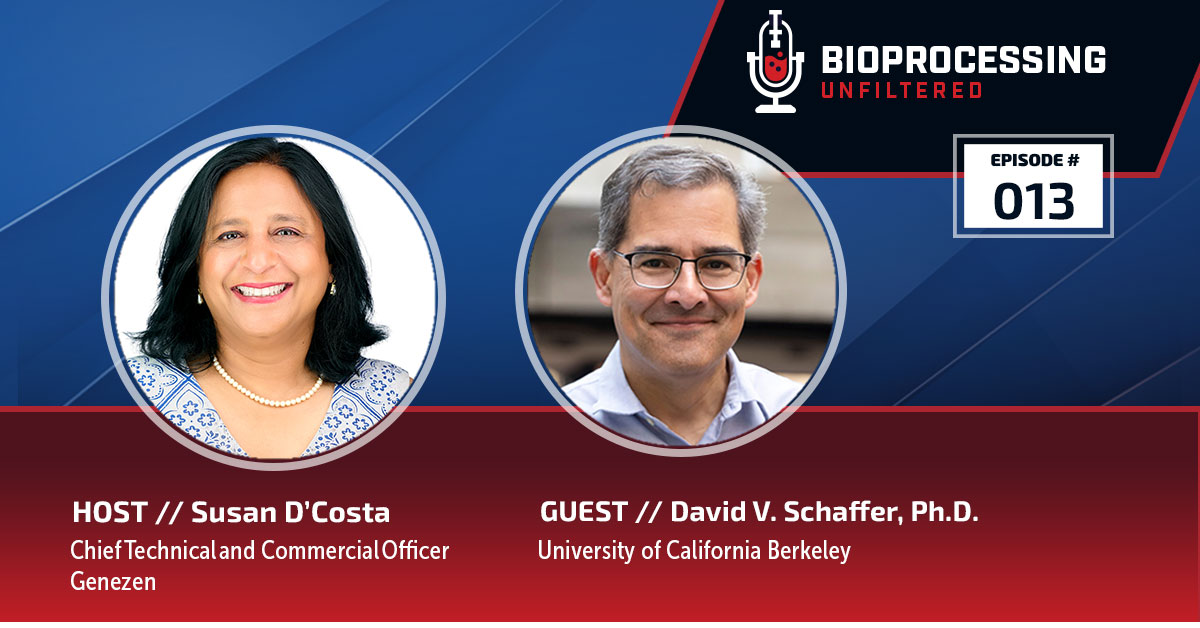
Susan D'Costa talks with Dr. David Schaefer about what gene therapy manufacturing has truly improved and where AAV vector production still breaks at scale. They connect capsid engineering, QC-friendly analytics, AI-driven directed evolution, and today’s global biotech competition into one practical view of clinical translation.
Listen in for:
- why viral vector production strains cell viability and limits throughput
- how AAV manufacturing evolved from roller bottles and ultracentrifugation to suspension bioreactors and chromatography
- how to reduce bespoke downstream work by selecting for manufacturability early
- which analytical methods become painful in QC and why neutralizing antibody assays are often bespoke
- why local delivery can reduce immune risk and off-target liver exposure
- what China’s growing role means for innovation, deals, and competitiveness
Covering both upstream and downstream processing, analytics, AI and digitization, cell and gene therapy and more, Bioprocessing Unfiltered is your insider's pass to the researchers tackling—and solving—the day-to-day challenges in the bioprocessing industry.
HOST BIO
Susan D'Costa, Chief Technical and Commercial Officer, Genezen
Susan D'Costa is a molecular virologist spanning 25 years of experience in virology. Over the past twelve years she has translated her expertise into viral vector gene therapies where she has been actively involved in viral vector analytics, process development, manufacturing, and building successful teams. She serves as a board member for Elly's Team, a parent foundation focused on accelerating the translation of medical research into treatments. She also serves on the Scientific Advisory Board for Precision Biosciences, a clinical-stage biotechnology company focused on developing genome editing therapies using its proprietary ARCUS platform. Prior to Genezen, Susan was CTO at Alcyone Therapeutics, a biotechnology company pioneering next-generation CNS precision gene-based therapeutics for complex neurological conditions. At Alcyone, she was responsible for viral vector CMC, device development operations and partnering on new technologies for both gene therapy and precision delivery. Dr. D'Costa has also held leadership roles of increasing responsibility at Thermo Fisher Scientific, Viral Vector Services and its predecessor companies -- Brammer Bio and Florida Biologix, working with different viral vectors, liaising with diverse biotech clients and building teams with scientific and operational excellence. Susan holds a Ph.D. in biology, specializing in molecular virology, from Texas Tech University; an MS in biochemistry from Mumbai University (Grant Medical College) and a BS in microbiology/biochemistry also from Mumbai University (St. Xavier's College).
Susan D'Costa: https://www.linkedin.com/in/susan-d-costa-8877063
Genezen: https://www.linkedin.com/company/genezen-laboratories/
GUEST BIO
David V. Schaffer, PhD, Hubbard Howe Jr. Distinguished Professor, Chemical & Biomolecular Engineering, University of California Berkeley
David Schaffer is the Hubbard Howe Professor of Chemical and Biomolecular Engineering, Bioengineering, and Molecular and Cell Biology at the University of California, Berkeley, and he also serves as the Director of QB3, Bakar Labs, and the Bakar Fellows Program. He completed his B.S. at Stanford University in 1993 and his PhD at MIT in 1998, both in chemical engineering, as well as a postdoctoral fellowship at the Salk Institute for Biological Studies before joining Berkeley in 1999. There, he applies engineering principles to optimize gene and stem cell therapies, work that includes developing the concept of applying directed evolution to engineer targeted and efficient viral gene therapy vectors as well as new technologies to investigate and control stem cell function. He has published >250 papers, advised >100 graduate students and postdoctoral fellows, is an inventor on >50 issued patents, and developed technologies used in >10 human clinical trials. In addition, he has co-founded seven companies from his lab, including 4D Molecular Therapeutics (NASDAQ FDMT), Ignite Immunotherapies (acquired by Pfizer), and Rewrite (acquired by Intellia). Finally, has received recognitions including the National Academy of Engineering, National Academy of Inventors, Daniel I.C. Wong Award for Excellence in Biochemical Engineering, Andreas Acrivos Professional Progress Award, the American Institute of Chemical Engineers Pharmaceutical and Bioengineering Award, the American Chemical Society Marvin Johnson Award, the Biomedical Engineering Society Rita Shaffer Young Investigator Award, and others.
TRANSCRIPT
Welcome And Guest Background
AnnouncementWelcome to the Bioprocessing Unfiltered podcast. Each month we host conversations with the researchers and leaders tackling and solving the day-to-day challenges of the bioprocessing industry.
Susan D'CostaHello, good morning. Welcome to another episode of Bioprocessing Unfiltered. I'm your host, Dr. Susan D'Costa, and I'm here to present to you my guest, Dr. David Schaffer, who is the Hubbard Howe Junior Distinguished Professor from UC Berkeley. Dave, do you want to introduce yourself? Tell us a little bit about you, and tell us about your career trajectory.
David SchafferSounds great. Thank you so much and thrilled to be here. So as you mentioned, I've been at UC Berkeley as a professor. It's actually now over 25 years in chemical engineering, biomolecular engineering, as well as molecular and cell biology. My lab focuses on gene and cell therapies and specifically on developing technologies to be able to reduce barriers to clinical translation and success in human patients. In part of that capacity, I've been involved in starting up a number of companies, nine so far, that have either gone public, been acquired, or are private and growing. And my last hat is that I direct an institute called Bakar Labs, which is the largest university-owned and operated network of startup company incubators.
Susan D'CostaAmazing.
Manufacturing Bottlenecks And Scalable Unit Ops
Susan D'CostaSo let's start, you know, maybe talking a little bit about gene therapy manufacturing, if that's okay with you. I wanted to highlight that despite the significant advances in vector production, there is still a big major constraint for the field. It includes manufacturing costs, yield, consistency, as well as scalability. So from your perspective, both academic and industry, what do you think are the problems that have genuinely been solved while others are still underestimated? And here I'd like you to pay attention to maybe vector design as well, as part of your answer.
David SchafferSure. So on the plus side, gene therapy, most of us are thinking about as a one and done therapeutic, right? Single dose, single administration into a patient, long-term therapeutic benefit. Perhaps you need to redose at some point in the future. But as a result of that, the nature of that modality should be relatively limited doses. Yet it's such a complicated product that it's very difficult to produce. You know, it's not a small molecule, it's not a piece of nucleic acid, it's not a protein. It's a combination of the nucleic acid plus the protein around it. And in some cases, you know, as we know, a lipid bilayer wrapped around that.
Susan D'CostaCorrect.
David SchafferSo it is a very complex product that is produced, of course, in live cell culture, most often mammalian, sometimes insect or an alternate uh system. And one of the challenges associated with it is that viruses in one way or another often compromise during production, during replication of the virus, which happens during manufacturing, compromise the viability of the cell. So this means that the parts that make up with the virus, the nucleic acids encoding all the viral proteins and the cargo inside the virus, have to be introduced into the cell at the last minute. So you expand the cells in a reactor, you introduce the DNA constructs at the last minute. And being able to introduce DNA into cells efficiently and at very, very large scale to allow a process to go the 48, 72 hours to produce the virus, then the cells die and you harvest virus, that's that's really difficult to do. So there has been a lot of progress within the field. The very first FDA-approved gene therapy for a rare disease, which was an AV gene therapy, was is manufactured in roller bottles and purified using ultra-centrifugation. Both of these are non-scalable. You know, as a chemical engineer, I'd call it a non-scalable unit op. The field, I think, has really matured in many ways. So we're now we've moved initially into large-scale adherent cell bioreactors because the transfection required cells to be adherent, and have migrated beyond that to suspension bioreactors, which is inherently much more scalable. And the techniques needed to transfect cells in suspension have been developed. So, and in addition, on the downstream processing side, we've of course moved from ultra-centrifugation, which is inherently limited in scale, to scalable unit ops such as affinity chromatography, ion exchange chromatography, followed by the form, fill and finish, which are also scalable. So from start to end, it's now a scalable process, including all the way back to the plasmaid manufacturing, necessary for the cell transfection. But still, it's it's a complex series of unit ops, and as a result, the throughput is still somewhat limited. We still need to make progress, for example, with things like cell line engineering.
Susan D'CostaThanks, Dave. That was great.
Why Engineer AAV Instead Of Accepting Nature
Susan D'CostaI do want to kind of tune in a little bit on vector design, because you know we work with primarily as part of manufacturing adeno-associated viral vectors. Great tools, but and there are about a hundred naturally occurring serotypes that you know provide some level of tropism. But your work has involved actually going beyond that and kind of navigating some more vector design. Because we think of these as nature's way of providing transduction and entering into a cell, so great delivery vehicles, but they're not necessarily intended to be human therapeutic weapons, right? We're building them that way. And I love to say this viruses are slobs. That's what my PI, when I was in academia, Dr. Richard Condit, would always say viruses are slobs. They're not intended to be factively efficient. They're intended to be able to generate enough DNA or nucleic acid so that they can get their genetic material to the next level. So I'd love to hear your thoughts on maybe vector design a little bit more, on how that has influenced manufacturing and scalability as well.
David SchafferSure. So I've been working on vector design for 30 years or so, initially with non-viral, and over the past uh 28 years or so with viral, primarily AAV. And the motivation for that is that if we think of other therapeutic modalities, we of course design small molecules. Medicinal chemists have been doing that for a century, right? To be able to get the right properties, the right bio-distribution, the right solubility, et cetera. We design large molecules, antibodies. We've been doing that for several decades now. That's of course what turned Genentech into the company that it is.
Susan D'CostaCorrect.
David SchafferWe design more complex modalities like CAR T's. The car has been very exquisitely designed to be able to recognize an antigen and signal optimally into the T cell. So why shouldn't we design viruses? These natural viruses, AAVs, uh, that have been used for a lot of gene delivery are off the shelf. We don't really know the evolutionary pressures that shaped their properties. We are not controlling their delivery. We're not targeting them the way that these other modalities have been engineered to be targeted. So when I started my lab back in 1999, our job number one, our focus was really engineering AAVs at the molecular level to turn them from rather weak respiratory viruses into targeted delivery vehicles for all the various tissues that we would like to target them to to treat disease, whether it be in the retina, the brain, the lung, muscle, et cetera. So we began to apply this approach, directed evolution, which was invented in the early 1990s by an investigator who was applying this, you know, conceived of, and it was applying this concept to be able to engineer different versions of enzymes. And uh that technology went on to win the Nobel Prize in Chemistry for Francis Arnold in 2018. We started applying it towards AAV in the late 1990s, and it's turned out to be a very potent, powerful tool to re-engineer the properties of AAV and make it optimal for delivery to any tissue of interest rather than for settling for whatever nature happens to have thrown over the fence at us.
Susan D'CostaThat's cool.
Directed Evolution To Clinical Programs
Susan D'CostaCan you tell me a little bit more on like the progress that you've made in this space starting, you know, very early in 99 and how you've kind of evolved this conversation to today? Have any of these novel engineered capsids made it into the clinic? Have they made it beyond the clinic to a commercial conversation? And how do you envision this to look like as it continues in the future?
David SchafferSure, we developed the concept over the you know late 90s and then 2000s and really began to, in the late 2000s, apply it in systems that we felt were translatable to human trans to human clinical use. You know, initially we were doing a lot of technology development in cell culture as a proof of concept. And then really in the late 2000s started doing directed evolution for delivery to the retina, to the lung, and to other tissues, including muscle. So we're grateful that vectors that we've created or where our technology is created within a company I co-founded, I have entered into over 10 human clinical programs, primarily within the retina and the lung. Our vectors are currently in three phase three human clinical trials, primarily within the retina and a phase two and lung. And, you know, the first of those trials is going to release data in the first half of next year, which we hope, you know, based upon the positive results in phase two, are gonna place that product on a path towards FDA approval in somewhere 2029, 2030. So, you know, it's interesting that it's like I mentioned, it started working on the technology in around 99, and it will take maybe until 2029 to be able to get that into an FDA-approved product. As we all know, clinical development is relatively slow, and gene therapy has had, you know, a couple of interesting transitions during that time. But I'm thrilled, at least, you know, within the span of my career, we're gonna start getting FDA approvals. Hopefully.
Making Novel Capsids Less Bespoke
Susan D'CostaThat would be phenomenal. But, you know, as we think about these new vector designs, one of the thoughts which, you know, plagues me as a manufacturer, because you know, that's what Genison does as a contract development manufacturing organization, is we've got to figure out nimble ways to be able to get to GMP, to the clinic, and less time spent in process development, tinkering around with optimizing the process. But every time we bring in a novel engineer capsid, manufacturing, especially downstream, becomes bespoke. It becomes custom. We've got to tweak it just right. We've got to get the optimal productivity, we've got to get to recovery. Your yield is a conversation we need to have. Do you have any ideas or thoughts about how we can get to, at least philosophically, get to a place where this can be less bespoke and this can be more agnostic?
David SchafferSure. I can talk about some of the properties that emerge from this from this process, the technique and the technology inherently involves creating a single version of AAV or maybe a collection of natural versions of AAV, genetically diversifying them to be able to introduce changes in amino acid composition throughout the coat of the virus. And then taking using that resulting library, which at this stage is billions of variants in number, and applying a high throughput selection, such as injecting it or administering it into an animal model and then recovering the target cells or the target tissue to be able to sequence and identify the AAVs that made it there. So during every step of that process, and we typically iterate as this large pool begins to converge down to a small collect uh handful of variants, and we've accelerated that process with some innovations from incredible investigators in the field working on AI. But uh, we every every step along the way, we're manufacturing the library, we're packaging it in a process that's somewhat similar to the final ultimate process that we would use uh for manufacturing a single vector to go into a patient. So the vectors are selected not only for the ability to infect the target cell and reach it, but also for the ability to be packaged.
Susan D'CostaI see.
David SchafferSo we typically get vectors that are at or sometimes a bit better than the manufacturability of a wild type vector as a comparison. In some cases, we end up with something that's incredibly infectious but not very manufacturable. You know, it it shows up because it's high infectivity makes up for its lack of uh productivity. That's been pretty rare though. And we typically set those aside because they're not good candidates for advancing to the clinic and into GMP manufacturing, as you mentioned.
Susan D'CostaYep. So when you say manufacturability, I think you're correct me if I'm wrong. I think you're trying to say that these are enriched for full particles. They're enriched to have the payload and conserve that payload across the production cycle. But then even so, right, because now we've come up with these tools in downstream purification that, like you talked about affinity capture and other polishing steps that use chromatography. We're coming up with looking at the conformation of the capsid and how it binds to the tag of the affinity tag. And so, for example, the porous nine capture-select column from Thermo Fisher is very uniquely built. So it recognizes the conformation of the capsid for AAV serotype 9. That's a naturally occurring serotype. But there's so many variants of serotype 9, whether they have been selected to be specific for cardiac tissue, whether they've been selected specifically to cross the blood-brain barrier, and all of these novel variants. And I'm sure yours are similar to that. They no longer bind the affinity capture porous nine as well as we want them to. So our recoveries are now coming up at 20%, 30%, which is a huge loss because now we're thinking about scaling these much higher. And I'm trying to think of ways that we can continue to use our known affinity tags so that we can build this faster. Do you have any thoughts or can apply in any way on that context?
David SchafferSure. So typically the regions on the surface of the virus that are diversified or changed are ones that are involved in cells binding to sorry, virus binding to the cell surface or interacting with tissue or extracellular matrix. And those are inherently hypervariable regions to begin with. You know, we're changing their composition in very different ways compared to natural variability, but those are hypervariable regions. The affinity resins you mentioned, like we use AAVX a lot, not endorsing a particular product, but it's a terrific one. That binds to a highly conserved epitope on the virus.
Susan D'CostaI see.
David SchafferSo typically the variants that come out of the selections that we do are still binding to those resins that have an antibody or you know, VHH or what have you against a conserved part of the capsid. On occasion, we we come up with variants that don't. But generally, out of an evolution, we'll end up with a handful of variants that have interesting properties. And if one is not optimally manufacturable or doesn't bind to a resin or perhaps doesn't infect a mouse because we would still like to be able to use mouse models, which are the most effective efficacy models, as we all know, then we simply set that aside in favor of one that does have those those properties. So typically the the first step in the at the in the chromatography, the affinity, still works. Ion exchange, you know, we're often changing the surface charges of the capsid that often has to be re-optimized. And you have to re-optimize other steps along the way, such as the plasmid amounts and the relative ratios or stoichiometries of the different plasmids. So there is that bespoke element to it, which you mentioned, but hopefully you know the important steps are staying fixed.
Susan D'CostaYeah, so it's more tweaking and optimizing rather than fully developing a process
Analytics That Hold Up In QC
Susan D'Costafrom scratch.
David SchafferYes.
Susan D'CostaI like that idea. But also then, you know, because we're tweaking and optimizing and coming up with a novel serotype, the analytics do get impacted as a result of that. Can you speak to what specific analytics we would have to make custom every time we develop or engineer a novel serotype?
David SchafferYes, I'll mention really quick that when we develop a novel serotype, we're typically doing it for a tissue almost as a platform technology in and of itself. So, for example, we created a variant for the retina within one of my companies, and that we use that variant for four different indications, disease targets within the eye. So, because it was very efficient at mediating delivery to many cells, you can simply take that variant off the shelf again and again as you begin to treat other indications in the eye, whether they be you know rare orphan indications or larger market indications. So once you go through the challenge of being able to optimize the CMC and the analytics for that capsid once, you get to reuse that uh again and again.
Susan D'CostaSo you're effectively developing a platform, if you may. And so then that platform then replaces and therefore allows for you to build on the analytics. And so you're not just building it one and done, you're building it one and then extrapolating on that and exponentially growing that platform analytically, is what you're saying.
David SchafferThat's right, yes.
Susan D'CostaYeah, okay, that makes sense. And that that that is unique and I and great because, you know, I think a lot of times that this is something through my career I have faced because I've spent my time in QC and I've paid my dues in QC. When we think about analytics, a lot of times as scientists, we think about the cool esoteric ways of doing analytics. We don't think about the QC-friendly ways of doing analytics. And then when the assay fails and you're trying to look through OOS and OOTs and trying to understand how we can make this, that's when things kind of get a little bit difficult, if you may. And so having assays that require us to use mass specific mass spectrometry as an identification tool does not necessarily lend itself well. So I was wondering whether you partner with like vendors or tools and technology companies that as you're building a novel several type, they can think about building the ELISAs that would go with it to kind of bring that identity to the table.
David SchafferSo it it depends, you know, from you know, different clinical efforts I've interacted with. Each one has had its own regulatory strategy for analytics that are outsourced versus insourced. Of course, all the standard analytics are, you know, mycoplasma and you know osmolality, et cetera, are outsourced. And I think, you know, as a general rule, probably companies would like to outsource as as much as possible.
Susan D'CostaGot it.
David SchafferSo mass spec is is one of those pain points, I think. You know, hopefully once you develop it once for a given capsid, you can, you know, rinse and repeat. In some cases, neutralizing antibody assays are bespoke, and those depend on being able to tune the relative concentration of an antibody and a capsid.
Susan D'CostaFor sure.
David SchafferThe ratio of the the capsid and a cell culture if you're doing a inhibition of infectivity as a readout for neutralizing antibodies. So those are challenging analytics, I think, to develop and to qualify and validate, but hopefully it has to be done once per per product.
AnnouncementAre you enjoying the conversation? We'd love to hear from you. Please subscribe to the podcast and give us a rating. It helps other people find and join the conversation. If you've got speaker or topic ideas, we'd love to hear those too. You can send them in a podcast review.
Susan D'CostaI'm
Safety, Immunity, And Smarter Dosing
Susan D'Costagoing to steer you a little way away from manufacturing just for a quick moment and think about clinical aspects, right? We're talking about these novelly novel engineered capsids. And when we think about them in that context, we're thinking about tropism because we want to make sure that the majority of the payload is going to the cell, to the tissue, to the target that we want. Because that's the only way to ensure the efficacy of the dose that we're trying to get there. Which means a lot of times we have to de-target the liver. We have to make sure that that works. And the reason I start taking you away from manufacturing and focusing a little bit on clinical is there was a study that was, I mean, actually a clinical trial that was done recently with Capsida novel-engineered capsid. And that was a phenomenal, a phenomenal endeavor, but unfortunately there was a death, a patient death. Can you opine a little bit, if you're comfortable, about what do you think that meant or whether that kind of had a setback for the entire engineered capsid industry?
David SchafferYeah, I'll mention to begin with, our efforts have been predominantly focused on local delivery. That's something that I, you know, throughout my career have believed in. The manufacturing doses are smaller to begin with, so it spares manufacturing. Another advantage is that it doesn't necessarily expose the capsid to the full brunt of the immune system, or doesn't expose the immune system to the capsid, depending upon which way you look at it. And in addition, you know, as a result, you don't necessarily have to worry about off-target liver, for example, as a challenge. So we've done a lot of work in the retina with local administration. You still have to create a more efficient vector because natural vectors are not very good within the retina. We've done work on inhalation to administer to the lung. And then in addition, in the central nervous system, we've largely focused on local administration, either direct into parenchymal injection or CSF administration to be able to get vector to spread somewhat. So I we have shied away from systemic administration because of the, you know, in some cases, very large doses that are required because of all those off target sinks that you were mentioning, for example, liver. In addition, due to I think some of the challenges that we've all been facing as a field with immune surveillance and immune recognition of AAV. So Capsida, as you mentioned, has been working on intravenous administration. I have been selecting. Vectors or designing them for delivery to the central nervous system. I we, you know, this is our personal preference. We've been working on local administration to the central nervous system, but you I respect what what Capsida has been doing. They encountered, you know, an SAE that was in some ways similar to ones that people have been encountering when they're trying to get vector to muscle, which is, you know, immune responses potentially, I mean, I think there are a lot, there's lots of information floating around. I try not to stay anecdotal, but at least from what I've heard, it was some combination of systemic plus potentially local within within the CNS. So I think as a field, it makes sense to, you know, most definitely engineer highly efficient vectors within the most advanced animal models possible, such as for the central nervous system, non-human primate is is a really important model. And I think for now, at least we're gonna to to persist with local administration of relatively lower doses.
Susan D'CostaThat makes sense. And that's that's probably a very wise way of thinking through this. The lower the dose, the less the impact on the immune system, and therefore the better the ability to kind of stay efficacious, but not get all of the SAEs that come alongside the higher doses conversation, right?
David SchafferYes. And it's hard to avoid the liver. You know, if you do a direct brain injection, you're still going to disrupt capillaries. AAV is going to escape into circulation, and some particles are going to end up in the liver, but orders of magnitude lower compared to a direct intravascular administration.
AI, Fitness Landscapes, And Better Libraries
Susan D'CostaSo you've used AI and machine learning to be able to deliver and build out your capsids so that the vector design is next generation. So just curious about how you think about AI and machine learning in general, about beyond vector design. Like what do you think the future looks like for gene therapy in general, but also specifically from what's next for you in this conversation?
David SchafferSure. I think AI has been an innovative addition to the field. We weren't the first to do that. I have a lot of respect for that initial work. But it has been, in some ways, a natural for AV engineering, because, in its essence, what we do is to take these very, very, very large libraries, billions of members, put them through a selective challenge, and then sequence the winners, the ones that made it through. So in an initial selection, maybe you start out with a billion variants and maybe a hundred million make it through or several hundred million, but you can take a look at the patterns of that selection through sequencing to determine which ones are the fittest. For example, for every single AV variant, its own sequence, which it comes along for the ride inside the capsid is the barcode for the virus.
Susan D'CostaCorrect.
David SchafferSo you can sequence the original library, every single variant, or in some cases, Illumina can't quite sequence through a you know multi-billion variant library. And then you administer it, harvest the target tissue, such as cells within the retina, and re-sequence it. So you end up with two things a list of sequences, and second, the enrichment. How many times did that sequence show up after the selection, such as in the retina, versus before? So AI folks would call that a label data set. And it is a perfect data set to be able to do machine learning and artificial intelligence training upon. So the way I kind of think about it is that we are searching through a fitness landscape, you know, we're hiking through the Himalayas trying to find the peak of Mount Everest. And the chances that we stumble upon that peak with the experimental library that we have, which, while it sounds like a large number, a billion is a small number compared to the total theoretical number of AV particles possible. So the chances we stumble upon one experimentally that correspond to the peak of Everest is probably zero. However, you can take a look or the machine can take a look at the patterns of data and be able to find maybe not Everest, but Nepal. So you can find an area of high fitness within the fitness landscape and then focus your search on in on that region. Maybe you resynthesize a library that has the patterns that the machine learning tells you correspond to to high fitness, resynthesize a library, and then the chances you find like Optima within that landscape increase considerably. So it's you know, unlike enzyme engineering, where enzymes are a protein but not connected to the nucleic acid that encodes the protein.
Susan D'CostaRight.
David SchafferSo it becomes much more challenging to apply ML on enzymes because you kind of sequence separately from testing the protein property. In the case of AAV, the two are physically connected. The sequence is connected to the protein property. So it becomes possible to generate massive data sets. So it's unnatural for ML.
Susan D'CostaAnd then just curious, you know, you collect this huge amount of data, of which, of course, you're just trying to find that peak, right? That's your enriched fit uh uh fitness conversation here. But all the other stuff, the rejects, the the stuff that you have, is there value to rethink and recycle it in any way that because this is a good amount of data, does it fit for a better fitness with another tissue? Is it possible to recycle that way, or you don't think that's a possibility in itself?
David SchafferWell, we've been doing, and this is one of the challenges with ML, multi-parameter optimizations. Like I want this but not that. So I would like to go to skeletal muscle, but not liver, is an example, if one were doing a systemic administration.
Susan D'CostaOkay.
David SchafferSo perhaps in some cases I want liver but not skeletal muscle. So in that sense, you can recycle the same data sets from an initial round of selection as long as you collect data from a lot of different tissues and as a result be able to do multi-parameter optimizations.
Susan D'CostaRight. Okay.
David SchafferThat's uh those types of optimizations still excite the machine learning algorithm developers because it's new. It's if it's a single parameter optimization, those are fairly straightforward models now. But we hopefully, you know, keep feeding our collaborators very interesting problems to keep them very engaged.
Susan D'CostaThat's phenomenal.
China’s Momentum And The Next Phase
Susan D'CostaSo I have one last question, but it's also, I guess, the $65 million question for now. And that is today's market. How does China play a role in this? And what's the next phase for the field? I feel like the genetics medicine sector is navigating a very difficult path at this point, trying to find the right amount of finance, being able to commercialize these amazing vectors, but they come with their own impact as the headwinds kind of build up with CMC and otherwise. And then China is becoming an increasingly important aspect geopolitically across the biotechnology landscape. I'm sure you've heard of the investigator-in-CAD trials and how a lot of these first inhuman trials are opening up to get more clinical validation in China before they can come back to the FDA and kind of start here again. And that aspect is great. I'd love to understand what your thoughts are about all of this global landscape and how do you think the future is going to look like for this industry?
David SchafferSure. I mean, I think the US and Europe have been incredibly innovative and risk-taking and being able to develop gene therapy vectors, whether it be AAV or LENTI-based, whether it be for in vivo administration or CAR T's, for example. And there's been an enormous amount of progress over the past couple of decades. China has example, I mean advantages of a highly educated workforce. A lot of them are coming to Western countries and then returning to China. And their institutions are becoming stronger domestically as well, as well as I think terrific support from the government. The government views biotech as an investment in the future. And there's been an enormous influx in research dollars, in funding for direct funding to companies to be able to build up that industry. And they are catching up. Depending upon what reports you look at, somewhere between 40 to 50 percent of BD deals are between large pharma and small biotechs are now done with Chinese companies or with Chinese invented technologies.
Susan D'CostaRight.
David SchafferAnd that's that's the new landscape. That that's the world has changed. Yeah, that's that's probably not going to go away. So that means that we have to become more competitive, more innovative. A number of the Chinese-based technologies are with you know what you might consider to be more traditional therapeutic modalities, you know, small molecule, antibody, maybe ASO.
Susan D'CostaRight.
David SchafferAnd so if we want to continue to work on those areas, we need to be thinking about next generation, highly innovative. You know, for ASOs, for example, now there's a huge amount of innovation going on in targeting them or shuttling them to various tissues with anything from a peptide to an antibody. So that's that's you know, thinking innovatively next generation. With gene therapy, we need to be continuously thinking more innovatively about vector design, about downstream manufacturing. Because I think that as small companies take their risk and get their financing, which is hard fought, and advance their technology, maybe even get phase one data, and then start talking with pharma, they're going to be spending a few months looking in China first to see if there is a comparable technology available for less prior to coming back to you.
Susan D'CostaExactly. Yeah, that makes sense.
David SchafferAnd then sitting down at the table, hopefully still to be able to make a deal. So, you know, best case scenario, we have to wait longer to be able to get the same deal that we would have. And you know, alternatively, we don't get the deal. It ends up going to a Chinese company. But you know, the collectively, biotech is still advancing as a whole, and and patients are going to benefit as a result of this diversified development of new technologies.
Susan D'CostaThat's great. Dave, I have I've had a great time listening to you talk and I've learned a lot. So thank you for this phenomenal conversation. And this was a great uh uh chapter in the uh bioprocessing unfiltered conversation. And thank you to Dan Berry as well for putting this together and uh have a great day.
Stay Connected