

Andrew Sinclair Offers Insight on Optimizing Manufacturing and Operations, Part 2
February 3, 2026
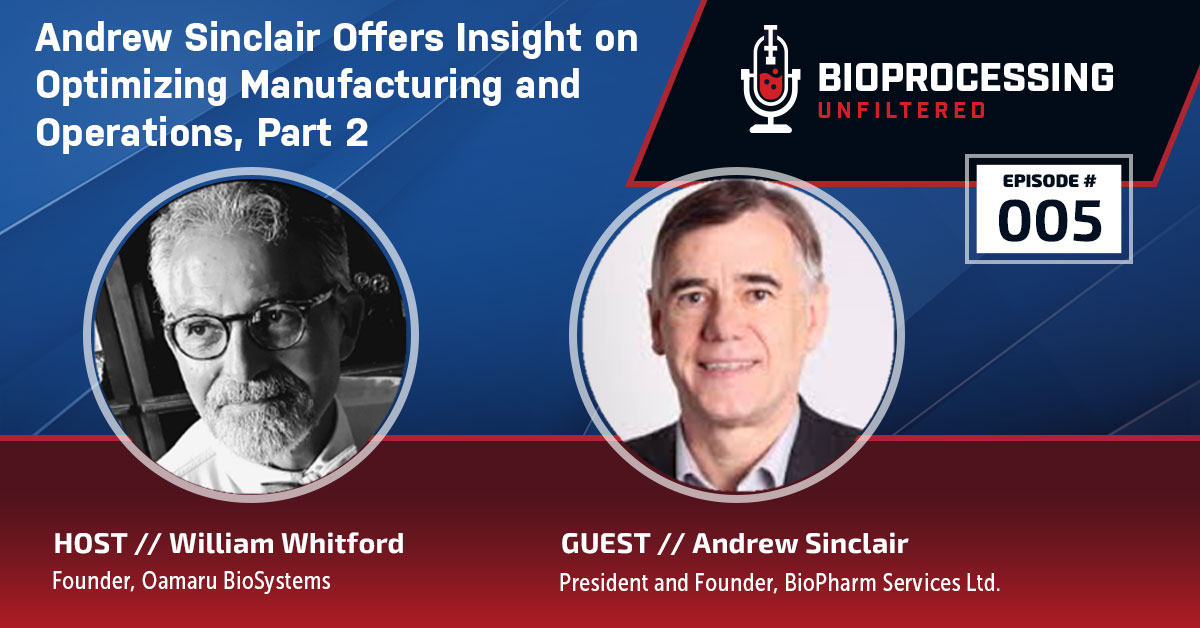
Picking up from their previous conversation on Bioprocessing Unfiltered, Andrew Sinclair, president and founder of BioPharm Services Ltd., and host William Whitford, founder of Oamaru BioSystems, discuss improving manufacturing efficiency, including process mass intensity and setting up parameters, and more on Sinclair’s long career and valuable experiences in the industry. Sinclair also shares advice on helping someone who cannot meet parameters, how to navigate new profusions, and default values that can help others with their processes.
GUEST BIO
Andrew Sinclair, MSc, CEng, FIChemE, FREng, President & Founder, BioPharm Services Ltd.
Andrew has over 30 years’ design and operational experience in the biopharmaceutical industry, with direct responsibility for manufacturing, logistics, maintenance and capital program management. He has developed BioPharm Services into a leading provider of bioprocess modelling and knowledge management tools that support bioprocess innovation. The focus of his work is on understanding the impact of innovative technologies on biomanufacturing with a focus on single-use systems and continuous processing. Prior to BioPharm Services, Andrew was director of engineering and logistics at Lonza Biologics and holds a master’s degree in biochemical engineering from UCL. He was a finalist in “The Manufacturing Processing Thought Leader of the Decade” category at the 2012 BioProcess International Awards and in 2014 was appointed a Fellow of the Royal Academy of Engineering in the UK.
HOST BIO
William Whitford, Founder, Oamaru BioSystems
Bill is founder of Oamaru BioSystems with over 20 years’ experience in biotechnology product and process development. He now publishes oral papers, print articles, and book chapters on such topics as ATMP process intensification, AI/ML tools, and net positive building economy in biomanufacturing. His work has been acknowledged in the 2022 APEX Award for Publication Excellence in the Technical & Technology Writing category and the 2023 ISPE Roger F. Sherwood Article of the Year award. He currently enjoys serving on such committees as the BioProcess International Editorial Advisory Board, and the chair of the 3SMAGNET Intersectoral Advisory Board. Bill has an h-index of 18 and an i10 index of 37.
TRANSCRIPT
Announcement:Welcome to the Bioprocessing Unfiltered podcast. Each month we host conversations with the researchers and leaders tackling and solving the day-to-day challenges of the bioprocessing industry.
William Whitford:Now, Andrew, you've in defining this, I one of the questions I was coming up on was talking about some of the metrics that engineers have come up with to look at the actual not the sustainability but the efficiency of manufacturing. Things like process mass intensity or or manufacturing mass intensity, which is another a publication I thought was an interesting development of PMI. Did do you want to include that at this point? Or I mean, or do you think you've you've talked around the the those concepts?
Andrew Sinclair:Well I was going to come on to that, but I want to say is that if we think about process efficiency and we're looking at in the context of these environmental factors and the cost factors, where do we actually have the biggest impact? So we have to look at the product development lifecycle. And with all of our products, once they get past preclinical, they go into phase one, two, three clinical trials and then go through to approval and then on to commercial. And when you analyze that product lifecycle, what you find is that 70 to 80 percent of the cost and the environmental impact will be set by the end of phase two. So that what that means is your scope for changing any of those parameters is limited after you once you get to phase two. And that's for very good reasons.
William Whitford:Because you're defining the frazzles, you're defining the values, and they really can't be changed.
Andrew Sinclair:Yeah. So you can't change a chromatography column for something else once you're into phase three. So what does that mean? That means that you're asking the process development scientists to think about how do they optimize the process from a cost perspective and an environmental impact perspective before they have any idea of what the commercial scale is or where it's going to be manufactured. And they don't necessarily historically have the means of getting an accurate metric for that cost of goods or environmental impact. So that's the kind of historical context. Trevor Burrus, Jr.
William Whitford:It seems to me that it could the just scale alone could radically change. It's not wouldn't be a linear function moving from a particular, for example, bioreactor to another scale of bioreactor, that could be a discontinuous change in your costs. Yeah, it it would be a difficult, a difficult proposition.
Andrew Sinclair:Yeah, so so there's a number of factors that play into that, but that is primarily why we developed biosol process. So if we go back to the early 2000s, which I call the Wild West days of monoclonal antibodies, everyone was looking at alternative approaches. You probably remember that transgenic goats, transgenic rabbits, tobacco plants, maize. Yeah. So and part of what was going on in those times is that we as a when after I set up biopharm services, we were asked to do cost of model, cost of goods model after cost of goods model. And we probably did 50 to 100 models for organizations around Massachusetts and wherever else in the world, looking at trendsendic this, expression in eggs, etc., etc. And every time we delivered a model, the person would say, Well, that's a nice model, we can change the scale, but can we change the process sequence? And because you know you're doing it in Excel, that's not is not very feasible. So that that led us, together with some other work we were doing on factory simulation, to understand how you could deliver a modeling platform where the user can configure the process and change the process and look at the outcomes and consequences of that change.
William Whitford:And if I could interject here that it it biofarm services actually supplies such a program. So you you could help someone get set up in that.
Andrew Sinclair:Yeah, so that that was the driver for us developing the software. It's really saying it was really driven by the users wanting a tool. And to actually do that, what you have to do is you have to take the process information and you have to also understand the information that people have is not necessarily complete. And then you have to give it a sort of commercial relevance. And then I come back to the database again. So the database is vitally important because it it sets the parameters of what equipment is actually available, what sizes are actually available, so that when you try and match your process and scale to actual equipment, it's it's pulling in what are real equipment. So it's giving a a proper relevance to the process that you're trying to model.
William Whitford:You know, coming from RD, this is a a business perspective that I just never had. I've always been on the lab bench in small scale. And and the the problem with with being very practical in making these models, looking at what size bioreactors exist, what what size packaging raw materials exists, and that that it's not a matter of science. It's literally a matter of business and and practicality.
Andrew Sinclair:Yeah, and that's that's probably what the software is trying to do in that situation is take all of that away from the scientists. So all the scientists has to do is map in the process, and they will get a perspective and they set the scale and then they will get the cost output, but they'll get a lot of other information. Because to get to the cost output, you effectively have to model the factory. So what you have to do is the is fill in the gaps of what the user hasn't defined. So you have to have a lot of embedded knowledge in the platform. So typically what are all the standard unit ops, what standard template processes, so that the user is just putting in what they know to get an output.
William Whitford:I've got a question in that area. You as a provider of this service or or platform, what do you do if someone doesn't have an answer for one of your important parameters? But they want to turn the the crank, they want to get a value without this particular piece of information. Can you give some range of qualification of the answer based on the fact that they can help you there? Did that ever happen?
Andrew Sinclair:Well, it's it it's an interesting point because so if you take the monoclonal antibody process, you may have a a reasonable understanding of what's happening in the upstream, how long you're gonna take. You may not have done sufficient work in the downstream, but there's a template process that has the sort of typical platform process. Now you can run that and that gives you a value, say, for cost of goods, but it also tells you the cost distribution and it identifies what the primary high cost items are, and it may say for that's protein A, and you may say, well, I to get a better handle on cost of goods, I need to get a better understanding of the binding capacity of protein A for my product and things like that. So it it by having default data, it it's not really a substitution for getting real data, but it it guides you to where to focus. And that's as important. So where you've got limited time, you want to just focus on the important areas because 80% of the cost information that's being fed in through the raw material costs don't really matter. It's only those important areas in the process model that you need to worry about.
William Whitford:So you with your experience then, you do have maybe a library of some default values you could help someone with. They're not very good in downstream. You can say, well, depending on the resin binding efficiency is in this range, and plug that in just to get through it.
Andrew Sinclair:Well, that's the whole that that's the whole rationale for the the platform. So when we launched it in 2008, it was just purely batch processing at that time that people were considering. So we had template processes for mab, microbial and vaccines, and that was about it. But what we do is as the industry evolves, we put in the new modalities as templates and the new processes. So, for example, if we look at the product today, it can simulate continuous processing, it's got all the resources and information required to support those product processes.
William Whitford:Well, that's interesting. If I can interrupt. Yeah. You know, if if someone is is operating some new perfusion even a commercially available perfusion device, but they don't really know some of the values of these efficiencies. They don't have that much experience. Now you s you do you think you have familiarity enough, having used it before, that you could help them to just throw this in for the time being until they have to.
Andrew Sinclair:Yeah, well, we we would have a standard perfusion model that they can play around with, and then they can do their own what if. So a good example in perfusion is your flux rate on your perfusion membrane. You know, what is it? Ten liters per minute per hour per meter per hour, whatever.
William Whitford:That would be a big and that would be a big cost risk.
Andrew Sinclair:Yeah, and, you know, but they go down as and some people go down as low as one. You know, in pr so it it's a starting point that gets you going, and then you can then you've got a point to measure against. So if so you're interested in a perfusion process, it comes with default values. You you set up your sort of baseline process, you then set your thing, well, I need better definition on that one because it's important. So a good one in that case is is the flux rate for the perfusion module. So you go away and do some lab tests. And so but it's interesting because early on when we developed the software, I was approached by a very experienced process development guy who'd come out of JNJ and it was with a startup. And he was in a serious conversation with his investors, and they were making a a scar protein, a protein that minimizes scarring. And his investors were saying, Well, you can extract this from blood, why don't you just keep doing why don't we just keep doing that? And and he was saying that's not gonna work from an economic perspective. And so he commissioned us to do a range of models in in Biosolve to look at different expression systems.
William Whitford:All right, so this is this is not I was thinking about tuning your Biosol with actual data, but you but you can just bring purely simulations and say this is what it would be, you know, assuming standard parameters for perfusion for standard you can you can run these purely from the libraries of existing information having nothing to do with current development work.
Andrew Sinclair:Yeah. So what in his case, he we we did microbial with soluble and insoluble, mammalian and so on. And what he did, he he looked at the results and he said, Well, I need to do some small lab experiments to validate some points. And he did that very quickly because he was experienced and he knew what what the key important parameters are, adjusted the models, and then he we looked at different scales. So you could see, for example, at small scale the cost differences, say between microbial insoluble and soluble and memelee weren't great. But as soon as you scaled it up to commercial, you know, microbial soluble became totally uneconomic where you're using guanadine hydrochloride, whereas if you used urea, it was it was on board. But he was also able to use that data to go back to the investors and say, look, for for an anti, you know, for an anti-scarring protein where it's it's not acute, is you know, is for a cosmetical reason. If we go down the blood fractionation isolation route, it's going to be totally uneconomic. And so you're able to have an informed. Yeah, and you can so but the that same principle applies to any any situation. You can then use it to inform a discussion. So you take the opinion out. So you say, well, the opinion of the investor in that case was why don't we just use the simplest, which is blood fractionation? The experienced Pahid E guy said that that's not going to work. I know that's not going to work. But he had no proof. So he turned to bias or process and he did a whole range of options. And then he challenged. He went back.
William Whitford:Yeah. This is an application that I didn't know of. I thought people were using it to tweak their existing process, to consider, well, what if we change the a resin to you know that had different efficiency or or price or change you know if we would consider continuous. I thought that it was to model developing an individual's already known process weight. This is a new application that I I can see evaluating.
Andrew Sinclair:So if you think about who who are the people using it in terms of bias or process at the moment, it's a lot of people in early process development.
William Whitford:For what you've just described. Yeah. What if? What if we go this way, what if we go that way?
Andrew Sinclair:Yeah, so that was in in that that sort of use case was really born out of the early 2000s and and really pull from the industry saying, well, we need something. And the reason that's what surprised me was the level of engagement from suppliers. So suppliers give us data that we anonymize to populate the database so it's commercially relevant. It's in their interests and in our interests and the industry's interests.
William Whitford:And that that seems to me it would be a difficulty for you, is in in developing your repertoire of approaches, information you get that's publicly available versus working with a particular client. That would that that would be something you'd have to be very rigorous about, maybe it would be difficult to it in R D I didn't come across that very often. Where you you have to you have to res reserve knowledge that you may have gained in a proprietary sense and and not use it in another application now.
Andrew Sinclair:Yeah, that well where we do consultancy work or where we have proprietary information for supplies, that is sort of not used in the following.
William Whitford:Well, you know, that's kind of common. You know, it's a common but but in developing a model like that, it would just it would be i it's very difficult to it's a league, I think, of of Yeah.
Andrew Sinclair:So in terms of the template models, we do not use any proprietary information. Yeah, yeah. Yeah. Well, there's enough information in the public domain. So a good example is monoclonal antibodies. We worked with Bioforum and the industry to develop the standardized monoclonal antibody process for batch, hybrid, and single use, and fully continuous. So that we that was published as a formal set of recipes in 2018.
William Whitford:I remember that, yeah.
Andrew Sinclair:Yeah, so that that but to get to that point took a couple of years of effort from all parties to get a consensus. So that that was an important milestone because then it gave us all a reference point.
Announcement:Are you enjoying the conversation? We'd love to hear from you. Please subscribe to the podcast and give us a rating. It helps other people find and join the conversation. If you've got speaker or topic ideas, we'd love to hear those too. You can send them in a podcast review.
Andrew Sinclair:Now, when we come to the new modalities, so cell therapy. So we we have a standard cell therapy process in Barsolf.
William Whitford:That's interesting. Cell therapy, there are so many. How does that work?
Andrew Sinclair:Well, we focus on CAR T, yeah, because that's yeah. So but even then, and and it's the same with AAV, we we have template platforms, but the the issue with those is that the degree of improvement or change going on in those places is is quite dramatic, you know, quite dramatic. So we have to try and update those on a regular basis. And latterly you we have the mRNA. But the public the issue is that in all of those cases, a lot of that information is in the public domain. And we would only reference that. So we reference that as the source.
William Whitford:Oh, that's interesting. It in many of your packaged models, it it's easy for the user to find where this particular information came from.
Andrew Sinclair:You have that we have that in the reference materials. Yeah, yeah, yeah. So we'd we'd have the source. Yeah.
William Whitford:Because I'm sure many people have no idea where it would have come from, and it gives them a reassurance that it that it's a good value.
Andrew Sinclair:Yeah. So then, you know, once we so we probably have six or seven hundred users of the platform around the world, and so it it it was a good way, it's been a good way of standardizing on the way you communicate cogs within organizations and between organizations. Because what it means is you can you're not worrying about what methods people use, level of the boundaries around it is all predefined in that sense. And ever all the assumptions are clearly identified. But what was interesting, as soon as we launched, people were asking about environmental impact. And we had lots of discussions with our large pharma users, mainly in the US, who were asking for PMI outputs. And so in and Merck was actually Merck in Railway was the key driver for us to put explicit PMI reports in in 2017. And so what then became available is that you could get your economic assessment, but you could also start to evaluate PMI and understand the composition of it. So Basically, what the models would do is say this is the contribution from water, from plastics, from buffer media salts and gases and things like that. So you get and then it would also break it down by unit ops. So you could see where your big contributors were. And in the case of stainless steel, this comes to the MMI definition.
William Whitford:And just for the for the audience, process we PMI is processed mass intensity and MMI is manufacturing mass intensity, which are have a slightly different definition what they're including and how they're weighting it. But they're both good and and and neither are perfect.
Andrew Sinclair:Yeah, so PMI grew out of the small molecule industry, and it was very focused on the inputs and it specifically excluded cleaning. And so when we came to apply PMI to our industry, where we use very dilute solutions, water dominates. But more importantly, when you think about stainless steel, you use vast quantities as water for cleaning. So this led to a conundrum which really translates to this. If I'm moving from single use to stainless steel, or vice versa, if I'm going from stainless steel to single use, I'm saving a lot of cleaning water, but my PMI doesn't change, right?
William Whitford:But it's by the definition of by the formal definition.
Andrew Sinclair:So this is where the concept of MMI, which includes cleaning, and we have always included cleaning because it's so important and relevant in that sense. And, you know, that's where we are today. So as soon as we introduced PMI in the in in the 2017, people said, well, we want energy. Right?
William Whitford:So so Which is I understand not a parameter in even MMI.
Andrew Sinclair:No.
William Whitford:Yeah, you've got a you've got so but in so in your models are you now included and and have defined it?
Andrew Sinclair:Yeah, so the issue with energy is if you look at pharmaceutical manufacturing, high value pharmaceutical manufacturing and the use where you use clean rooms, there's a lot of benchmarking studies done in the US which show that the bulk of your energy use is associated with the clean room, not the process. So there there was a talk in the conference by Kem Hamilton, who's sustainability co-lead on Nimble in their process intensive education work stream, where he sort of presented saying that clean rooms easily contribute between 90 to 50 percent of the total facility energy load. So when people came to us and said, look, we want you to include process energy, I said, Well, there's no point, because it's not going to give you any indicator of your facility energy use unless you go to clean room. So we worked a couple of years working out how do we how do we take process information and estimate the clean room energy load? And it and it's not it's not straightforward. Because what you have to do is you have to say, well, okay, I've got my process, I put my scale in, and now I need to I know the size of physical size of the equipment, because we can work that out. And then have to say, well, what's the size of the production space? What's the volume of the production? What's the classification? So those are all things that we can do relatively easily. And then what you have to do is say, well, how much energy am I going to require to run the clean rooms or the spaces? And then you need to know climatic data. Because for clean rooms, if MR if I'm in a hot, humid environment, I'm going to use a heck of a lot more energy than I am in a in a sort of temperate sea coastal environment.
William Whitford:Having worked for an engineering firm for a while, I learned some facts I didn't realize that humidity can really affect the the energy involved in preparing the air.
Andrew Sinclair:So what we had to do is work out how do we define the climatic data to feed into the models. And because we could work out the size of the clean room, the classification, we know enough characteristics about clean rooms to know the air change rates. Anyway, so the the upshot was we were able to use climatic data combined with that information to estimate the annual energy load of the clean room, which is not provable. And then we work with the NIMBL sustainability team. So what NIMBL were doing is they were looking at the implication of process intensification and its impact on cost and its impact on sustainability.
William Whitford:And so they No, NIMBL being a consortium of of industry and academia, funded by the US government. Yes, working towards establishing some best practices for US pharmaceutical manufacturing, basically.
Andrew Sinclair:Or biofar so they're looking at the next generation of biopharm manufacturing. So that's very much their focus, and there you got hundreds of millions of money going into that program from a variety of sources. And so that they're very important. So what they're trying to do, so what they're trying to do in their process intensification case is come out with simple ways of assessing the LCA impact of process intensification. Now, to get to that, three of the NIMBL team companies were using Basel Process to model these process intensification options to populate the LCA, so to give the basic data that the LCA needs. And as part of that we were a we were able to estimate the scope too. So that's what they were interested in, in terms of supporting the LCA. But as part of that as well, they also were scrutinizing the accuracy and helping us refine the methodology.
William Whitford:Oh that's great. So it's a really contributed to helping them develop their their overview, and and then that you would get feedback from them as they examined your values.
Andrew Sinclair:And critiquing, yeah, and sort of trying to validate it from their perspective. And what they actually did, and this is what Kem Hamilton published, or presented yesterday, was they actually compared the prediction of biosole process to real facilities, five real facilities. And the metrics they compared were floor area estimation, boiler energy load, electrical energy load on an annualized basis, and headcount.
William Whitford:Now, the headcount, that was an interesting point that I came across in a couple of papers that for some personnel intensive Low volume like personalized medicines, the actual commuting carbon footprint of the personnel can be a significant factor in in the overall carbon footprint.
Andrew Sinclair:Yeah, we yeah, we did some work with Genetech in twenty or eight where we we that that was our conclusion. But we did a lot of work on LCAs with G healthcare when they were looking at the single useless as stainless steel, and we contributed to formal LCAs. Commuting is not included in LCA. So you can't include that. So that really I was quite surprised, but there it there is an argument why it isn't.
William Whitford:Well, see, this is interesting. This is the value that you bring to this type of discussion is from the academic papers, I see that it can be a can a serious contributor, but you're looking at the definition of the terms. What is a life cycle assessment, what is included, what isn't. You're like as I made the analogy to law. It's not so much what you think might be good, but what does the law say about this, or what are the regulations, or in this case, what is the definition of LCA? Yeah. And regardless of what you might think is a is a component, you know from your experience what it is and what what we do include.
Andrew Sinclair:Yeah, and and the interesting thing was in 2008, the commuting was the biggest contributor, right? That's from the Genetech study that we did with them, and we published it in a trade journal.
William Whitford:But the Maybe your paper is what I was thinking of. I don't know, I don't remember.
Andrew Sinclair:In t in 2011 and then right up to 2014 with G Healthcare, they were running the LCAs to the formal ISO standard, which meant they had to have independent auditing of that process, and it was fully mapped out as to what was included, what wasn't included, and the methodology, and it took two years. So it's not a trivial process, and it you get a lot of data out of it, but it it's nothing, it's not a trivial undertaking. So I'm always skeptical of people who just band the LCA around as if it's a generic some some number you come up with, because it to do it properly and to do it in a formal sense is a lot of effort. So you you come up you hear the concept of the simplified LCA.
William Whitford:Well, it's and you're what you're introducing here is that it's as important as have to have a model that's that's generating some values here, as it is to know the context of what organizations embrace one definitions, where where is this model applicable with respect to Europe or or the USA and that there's a lot of meta-analysis about regarding this model than than just the actual value.
Andrew Sinclair:Yeah. Yeah, so coming back to the Nimble stuff, when they benchmarked against five different facilities using the metrics I talked about, the scale of the facilities was from 2,000 to 20,000. So there was a real facilities that are part of the client. And all the values that Basel predicted were within plus or minus 20% of the actual metric.
William Whitford:That seems fantastic to me.
Andrew Sinclair:We were really surprised because if you think about it, we're just modeling from process information. And but what it does do is it gives us a degree it gives the users and ourselves a degree of confidence that, although it's not 100%, it's gonna be representative. So when we start to think about that situation in early development, we now have a tool which is gonna give us an estimate of scope two. So if we've got our net zero targets, we can then start to optimize our process in it in phase one and have some degree of confidence that we're we're optimizing the right things, which is unprecedented. Which takes us back to the point you made earlier about PMI. At the moment, because the majority users don't look at energy and don't necessarily have our software, they're using PMI. And as I said, PMI comes from the small molecule business. We have a different situation. So but PMI is very valuable in terms of understanding water use and raw material use. So I'm not undermining PMI. I think it's an important metric that needs to be addressed, but it doesn't tell us anything about energy. And we can demonstrate that with our models. So we can't use PMI as a predictor of scope two emissions. That's really been one of the things we've been looking at is what are other predictors of CO2 emissions for scope 2? And PMI is not that. But the interesting thing with PMI is that the if you look at the range of values for a pharmaceutical small molecule, they're sort of, I think, range from 50 to 200 max. So 200 would be a very high value. For us, flare monoclonal 3,000 to if it's a stainless steel small scale, 20,000, 30,000. Now, the interesting thing with PMI is the PMI value associated with the process doesn't change with scale. Because it's mass balance related. Okay. Yeah. But the PMI associated with cleaning water does. And it's it's a negative power law. So what you find volume than surface. Yeah, it's also tied up with that. So what you find is with stainless steel plants, the larger they are, the more the PMI for cleaning drops. But the other interesting thing is that if we look at PMI and strip out the water, for single-use plastics, we for a single-use process, we would have a PMI of 50 to 100. So what does that mean? That means we require 50 to 100 grams of plastic per gram of product. And with raw materials, that's for salts and stuff, that could be a hundred and something. So the numbers, if you strip away water, are still significantly significant and higher than you would see in the small molecules case. So that's why it's still important. And then if you then start to think about your scope three emissions, the embedded carbon coming into your process, then those start to have a degree of importance.
William Whitford:Well, you know, that type of discussion, bringing in the scope three, might be a topic of another day. I think we're we're running out of time for this episode. But I would like to thank you, Andrew. I think that you're the as I said, the comprehensive knowledge that you gain from working in so many different, not only individual organizations, but types of organizations gives a context, a wisdom that I find so valuable. So thank you very much for for joining us today.
Andrew Sinclair:Well, thank you very much, Bill. It's been a pleasure to talk to you.
Stay Connected